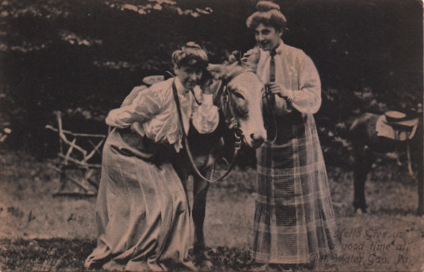
A man named Charles Williams, Jr. had the honor of having the first phone number in the United States. (It was 1, of course. Mr. Williams produced telephone equipment for Alexander Graham Bell, so he played guinea pig. (He also, by the way, had the second phone number—2–for his shop.) You can read the whole history around the Interwebs: how numbers were promoted over just asking the operator for the name of your party during a measles epidemic, which would make it easier for trainees if operators went home sick.

Direct dialing began in the 1920s, but calling the operator, at “Central”, lingered as ifferent parts of the country caught up with the latest in phones. (I missed it in my college dorm by only seven years…yeah, yeah, right after the Spanish-American War. Looked up that joke on your phone, did you?) For a while, calling “Central” was so well-known that it appeared in any number of pop songs: “Hello Central, Give Me Heaven” or “Hello, Central, Give Me No Man’s Land”.

Speaking of pop songs, if you recall “Pennsylvania 6-5000”, that represents a brief detour in many telephoned countries. As more and more phones were sold, numbers got longer and longer: three digits became four and then five. When they reached seven digits, executives rebelled. No one, they claimed, should be expected to remember a seven-digit number, so a word was substituted, and the caller was expected to use just the first two letters of the word.
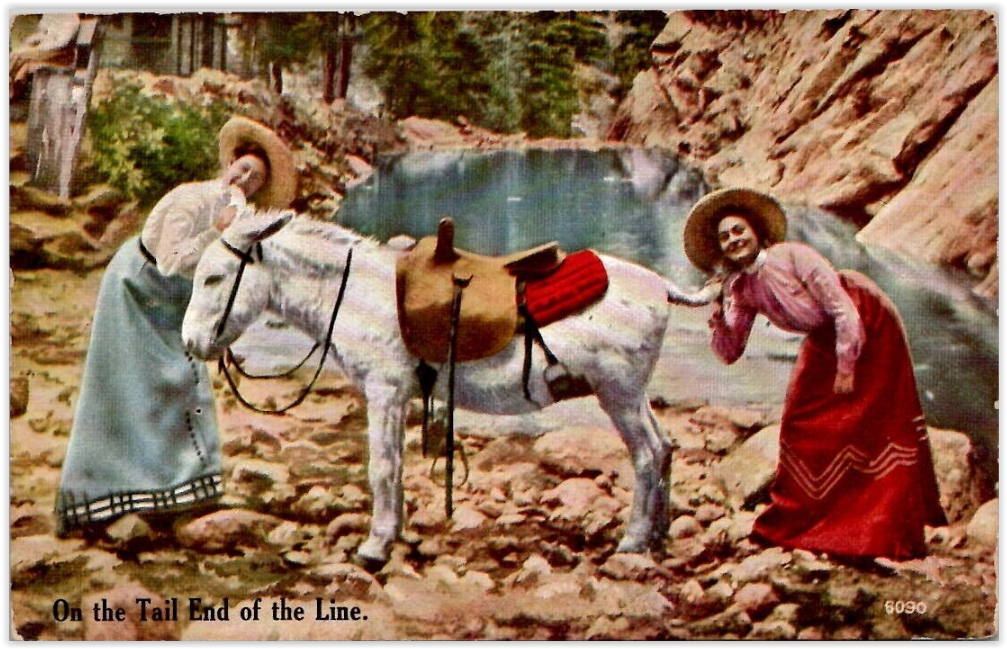
This is why your landline phones still have numbers next to the digits, creating trivia and mystery clues, since Q and X did not appear on the dial. (They do now, again creating problems for people watching old movies.) Other countries used other systems, by the way: in England, logic took charge over math when the Zero was assigned the letter O.
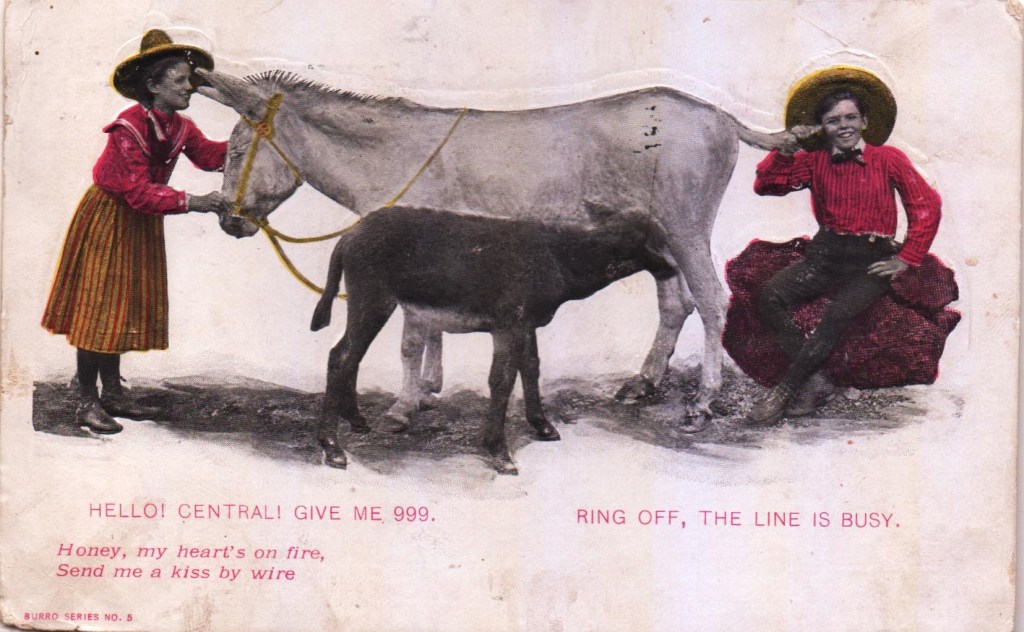
This eventually became cumbersome and, anyhow numbers went on getting longer. Area codes in the 1950s, with the biggest cities getting the numbers people considered easiest to dial. People seemed to find ways to remember these numbers without trouble. (Although, lemme tell you about calling 911, which started in the 1960s, suffered a slight pause for reconsideration because this was originally pronounced “Nine-Eleven”, and people were wasting their time looking for an eleven on the dial. Everyone started saying “Nine-one-one” instead, and children were taught this in school, often with a special pushbutton classroom aid which, as far as I can tell, is numbered backward, so I always see these kids proudly punching what will be, on a real phone, 7-3-3.)
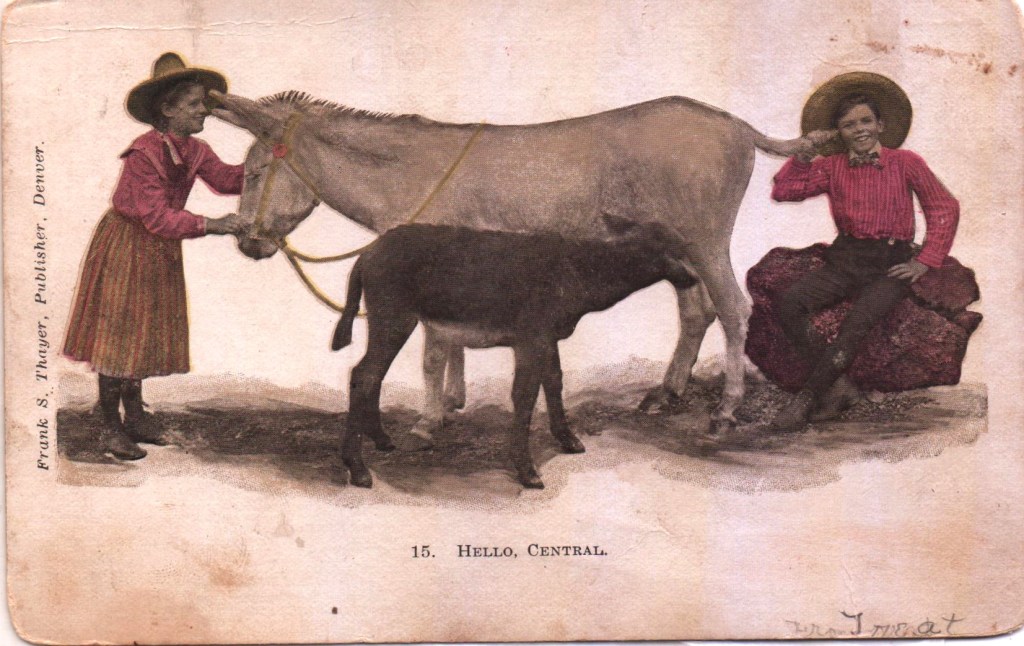
Now, of course, no one HAS to remember phone numbers. You simply type them into your phone once and then you just look up the name. The phonebook, thus, is dwindling away (how do little kids sit up to the table at Thanksgiving now?) and phone numbers ae losing the hyphens and parentheses I remember so well. We do still use a 1-3-3-4 arrangement of our numbers.

Other countries do a different division of their numbers, by the way: They also vary in whether they prefer hyphens or spaces or periods between the…my, we’re taking a long time to get to the question of why phone calls were associated with donkeys. I couldn’t find out anything st all about that: the Interwebs have their limits, somehow. Maybe we just had more donkeys around the house in those days, or maybe the joke sold best in western areas, where there were more donkeys than telephones.
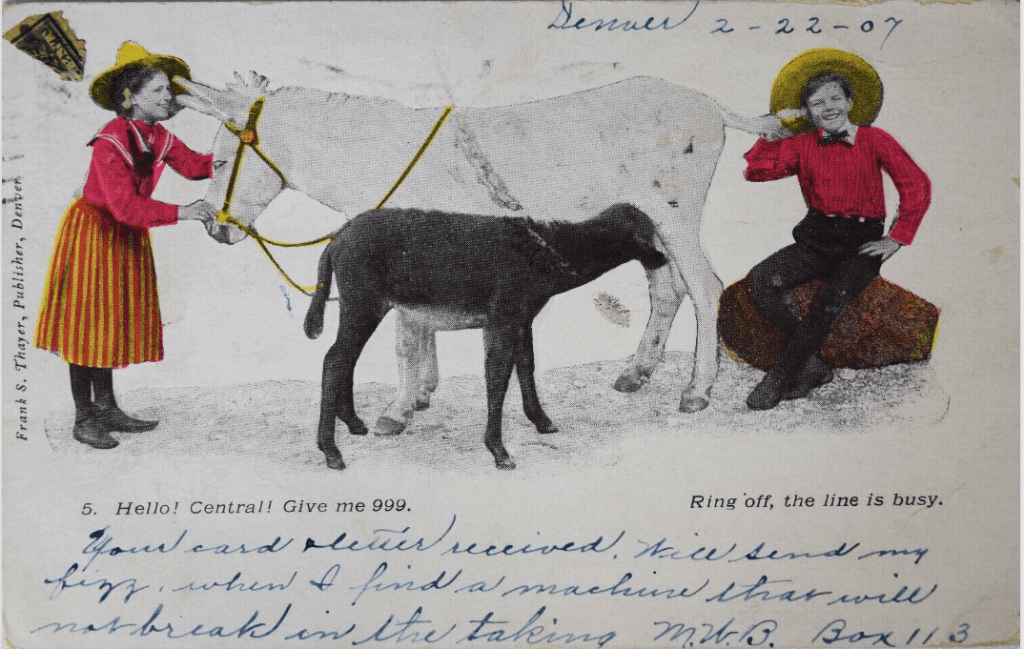
Nor can I do much more than illustrate how one simple photograph could bounce from postcard to postcard, with slightly different jokes. Other cards in my inventory play a similar trick: an identical picture above several different jokes, and nearly every one involves a donkey. A lot are from Frank S. Thayer, of Denver, who, as you can see from just these examples, must have sold pictures of his donkey to every tourist who passed through Colorado.
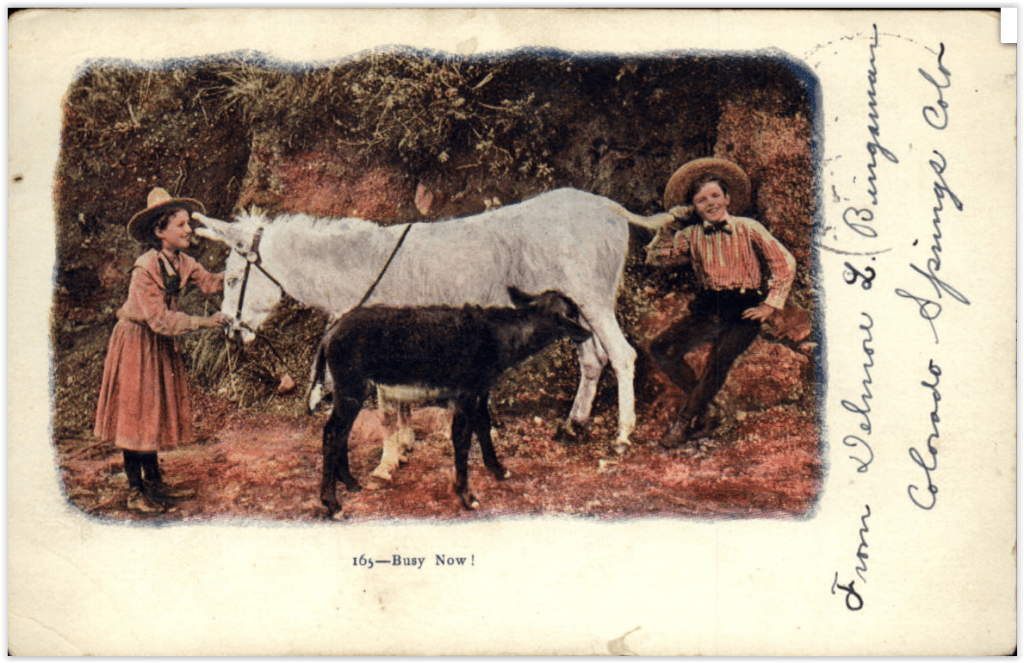
That’s probably the answer. Maybe when the boys in Thayer’s shop were short a card for the next season’s assortment, they would simply burro a picture.
 Blogsy Babbles