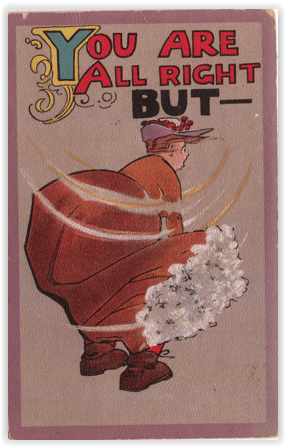
Flipping through my unsold inventory this weekend, I was made aware of something we have not yet covered in this column’s occasional pursuit of the butt in joke history. We have observed that our ancestors in the supposedly prudish era when postcards were born had no particular fear of using this particular four-letter word, IF it could be excused with a pun, as in the postcard seen above.

But (and I use that word with some trepidation) I noticed a goodly number of postcards warning us not to “butt in”, and references to some people being “buttinskys”. Several of these were cards featuring the heroes of our Dutch Kids craze, which puts the phrases back to around 1912, but others were cards with undivided backs, which, as you will certainly recall from our sketchy history of postcards in the United States, puts them before 1907.

Okay, this may not alarm YOU. But do you realize this means I have been using slang expressions which are at least a century old? Okay, you’ve seen my picture somewhere and that does NOT surprise you. Fine for you, pal.
So I headed out on a noble quest to track down the buttinsky to his native land, and figure out when he (or she) first started to butt in.
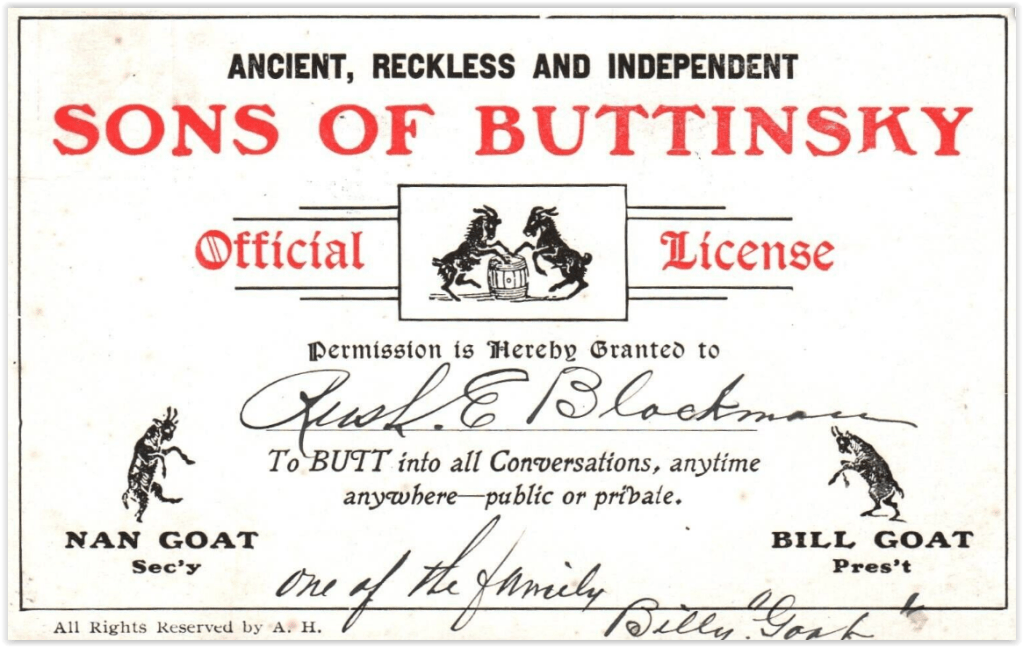
Despite the presence of a number of urban legends out there in the Interwebs, which would have us peruse the savory tale of Polish peasant Stanislaus Buttinski, who was eventually executed (beheaded or burned at the stake, depending on which part of the legend you like) for always butting in with advice at the Polish royal court in the 1680s, thus making his last name a watchword for…never mind. Despite that story, the phrase “buttinsky” was invented in the United States by a newspaperman who combined the OLDER phrase “butt in” with the name form of numerous Russian immigrants. He had someone accused of being a member of “the Buttinski family”.
Yeah, yeah, this does not prove that Stanislaus never existed. Just that nobody used his “famous name” for the first couple of centuries after he had his last meal of a hot steak or a cold chop. (Thank you, Home for Elderly Jokes.)
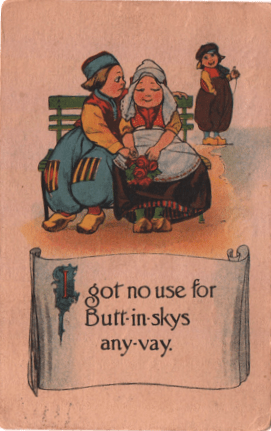
As to the phrase “butt in”, the slang experts online cannot find this being used before 1899. And the phrase owes nothing to the sitting end of the body. It refers to cattle trying to get to the head of a herd by putting their heads down and butting their way forward. It is a slightly younger brother of the phrase “horn in”, which is ALSO still used today, and lends a little more credence to this story. (All apologies to Stanislaus.)

You see where postcards fall into this history. We have a couple of slang expressions presumed new between 1899 and 1901, and a craze for postcards, which really began to build in 1903 or thereabouts. We owe to the cartoonists, I guess, the association of butting in with goats, which people in the city had a better chance of being butted by.

And Stanislaus Buttinski, along with all the experts who tried to tell me about people getting in line by pushing their backsides into a queue, will just have to butt out. (A phrase which has been traced to 1906, by the way, as an inversion of “butt in”. Pity. I was looking forward to the tale of Ladislaus Buttoutski.)
 Blogsy Babbles