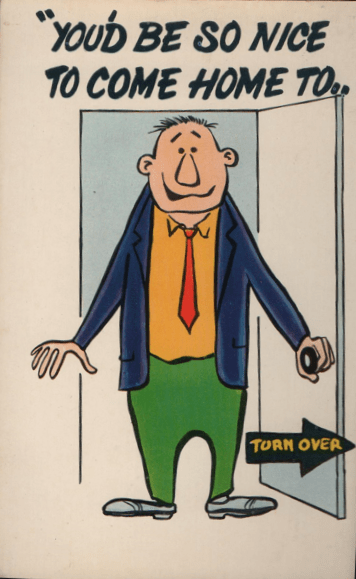
Once upon a time, I decided to make my next million (the first four or five hadn’t worked out) in the greeting card business. No, I did not warm up my toy printing press and start selling door to door. I planned to be a greeting card writer. Just like postcards, behind those brightly colored folders of wishes are writers and illustrators who try to come up with something new to say about birthdays and anniversaries (or ways to make the idea LOOK new.) I sold ten really nifty ideas to a company whose warehouse burned down, and finished my career about the same time. (Lemme tell you some time about my Belated Get Well cards.)

What has this to do with my usual line of blogs about postcards? Well, as the postcard market started drying up, a few companies experimented with developing the greeting card idea into lines of two-sided postcards.
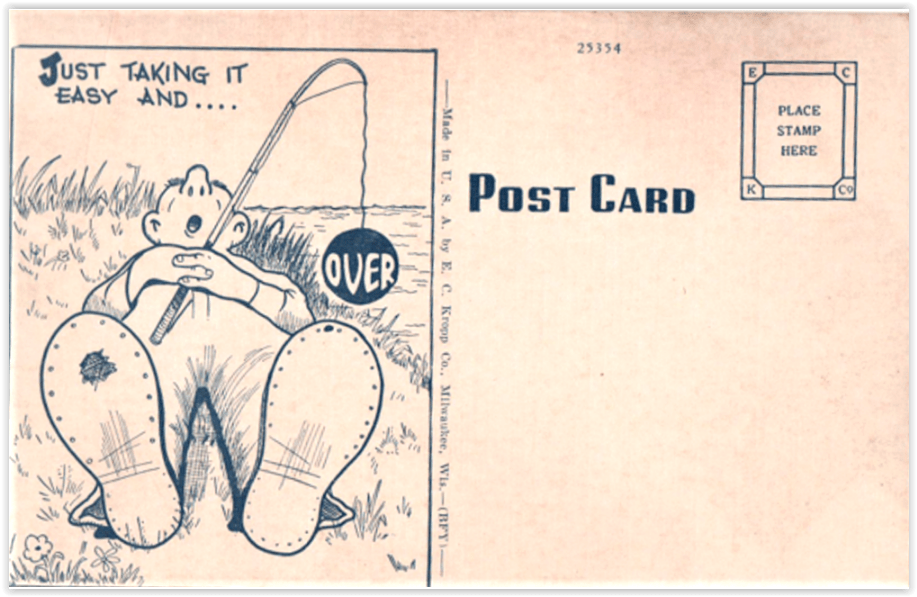
It was not so very far-fetched: you had two sides to a card, and there was no reason you couldn’t have the straight line on one side
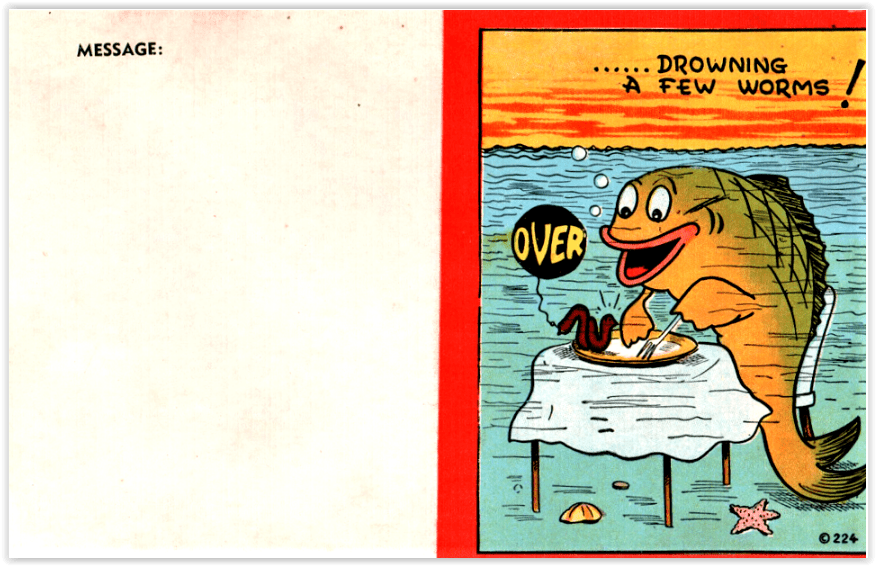
And the punchline on the back. The postcard application of a joke meant that it didn’t have to be for a particular holiday or occasion. People still sent postcards just to say “Howdy”, so gags that would not have worked for a greeting card which, after all, might cost a quarter to buy and three whole cents to mail would do perfectly well with a ten cent postcard you could send to your buddy for a penny.

A lot of the jokes reflect this. Before the end of the twentieth century, when “put-down humor” was called out as one of the causes of unrest in the world, sending insults to your pal was customary.
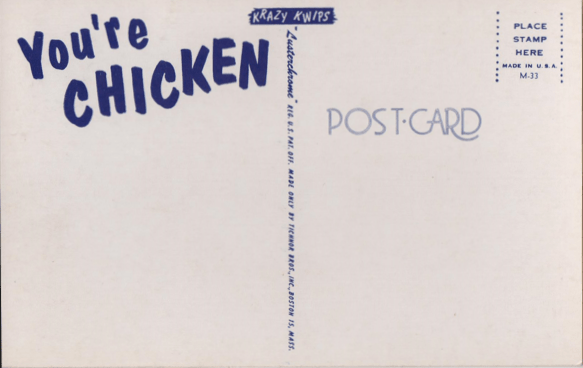
And as long as the punchline was short, you left a lot of room for the sender to put in other put downs, or just the usual “I am fine. How are you? Weather hot. Caught two fish.” (See, the joke could make the card worth reading, at least.)

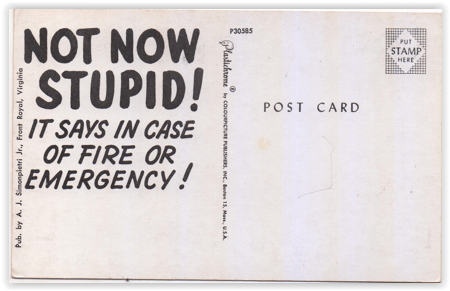
And it was nice to get some mail that wasn’t bills or advertisements: a little something to brighten the day. No matter how the card expressed it. (This gag seems to have been very popular; I have a couple of variations of it in inventory.)
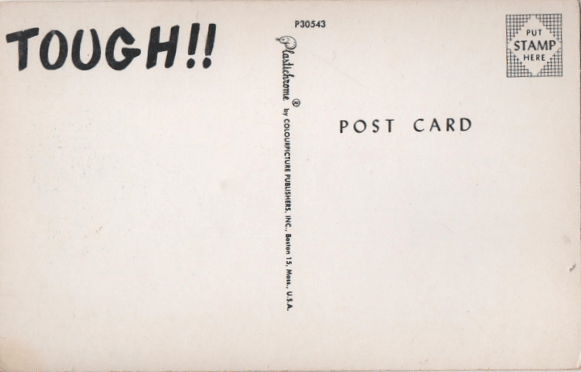
Perhaps the two-sided gag was also a blessing for freelance cartoonists, who might find two-panel jokes hard to sell to magazines.
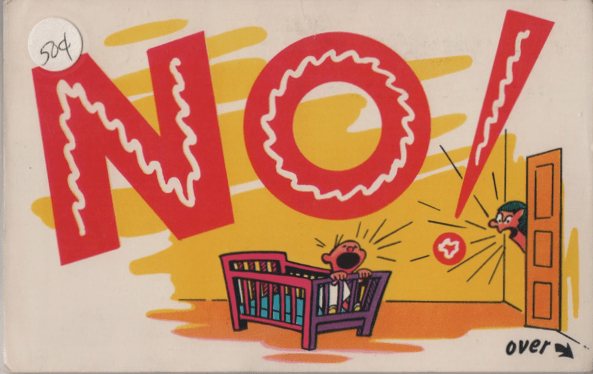
This might have worked in a magazine sixty years earlier, when cartoons were published with headlines AND captions. In the Fifties and Sixties, though, the time delay in having to flip the postcard over served as pretty good timing for the punch.
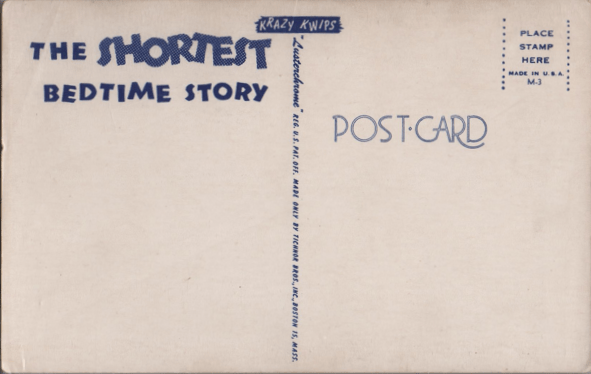
AND they were a boon to the mid-century fascination with coffee tables. You could buy these (or get them from a friend) and then just leave them on the coffee table for your guests to notice.

If your friends refused to reach down and flip the card over, you simply didn’t invite them to your next shindig.
 Blogsy Babbles