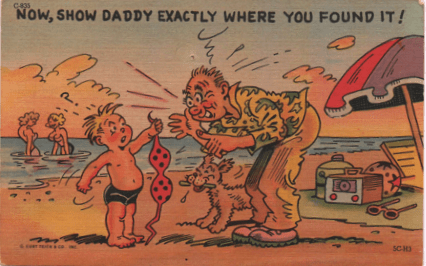
The Second World War was a period of frenetic scientific research in fields from medicine to meteorology. Among other things, it produced a study examining a way a man’s maturity could be estimated by what part of a woman their minds and eyes fixated on. Leg men, the study suggested, were the most mature, followed by the butt men, with breast men, paradoxically, at the bottom.
Some juvenile soul has objected to these columns of mine. (I know it will shock you to think there are people who read mighty works of literature simply to complain about them.) This reader noted my columns about postcard jokes about stockings, and claims to have lost count of the blogs on the human situpon. If I continue to ignore the upper torso, I am told, my column is a complete bust. (Tain’t new, friend.)

To make a clean breast of it (Serves you right: ti…never mind) there are not as many bosomy jokes in my inventory. Postcards before mid-century seem to pay less attention to the bosom. There are, to be sure, plenty of gags like the above, concerning padded figures, but an examination of the humor of the era suggests this was not very specific: whole bodies were padded or pinched, NOT just the chestal region.

Part of the problem is vocabulary. Donkeys and conjunctions provided excuses for using or suggesting the words “but” and “ass”. There were a few possibilities.

But in a world where even chicken breasts were referred to by the timid as “white meat”, what was a cartoonist to do. (As evidence that the jokes did exist, please refer to Abraham Lincoln’s joke about white meat. Whether he said it or not, it does prove that bosom jokes were not an invention of the 1930s.)
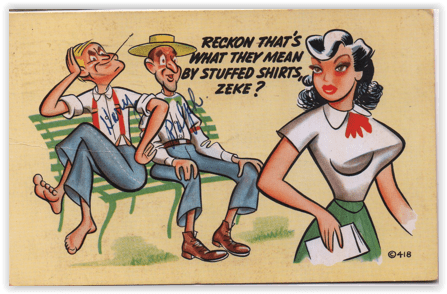
Of course, the euphemism can be made funnier than a simple straightforward observation.
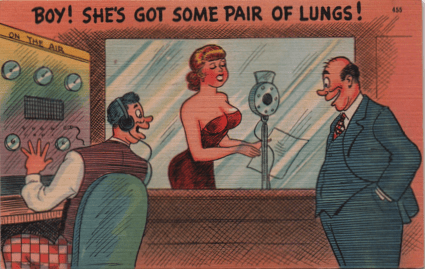
We don’t have time for the full story here (which I admit has never made anyone laugh yet, at least the way I tell it) but there is a guide to naughty phrases in French which points out that where an American would say a phrase which, literally translated into French, indicates “Well, she has an excellent deer hunting trophy” where a Frenchman says what literally translated means “Lots of people on that balcony.”
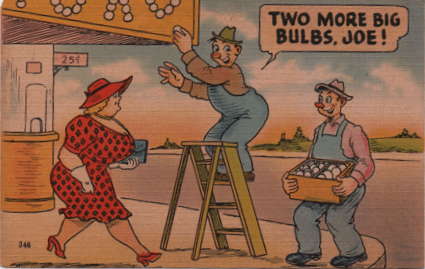
So a lot of the postcards which start to appear in the Thirties deal primarily with a principle defined in humor as “This means that, they say.”
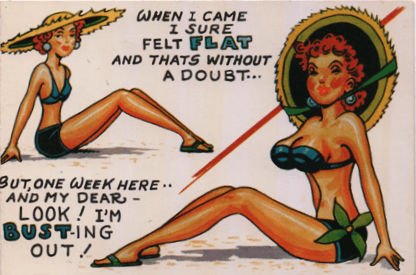
The use of some other phrase is often the whole joke. Sunshine and warmth do not actually work this way; you’re supposed to enjoy the combination of words and images and let the sense go by.

I’ve seen four or five postcards using this as a theme, none of which actually work very well if you pause to look them over. This is exactly what you’re not supposed to do. These gags are designed to go by quickly while you’re on your way to read what Nick (the bum) has written you from his vacation down south.
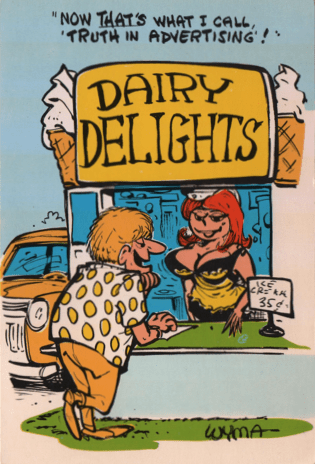
As the century went on, the cartoonists could become a little franker in their teasing. But by that time the era of rampant postcard mailing was becoming defunct.
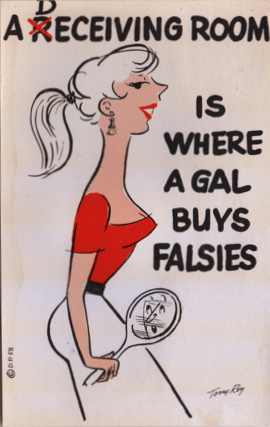
Although several of the jokes, apparently, were still going strong even after the passage of decades.
 Blogsy Babbles