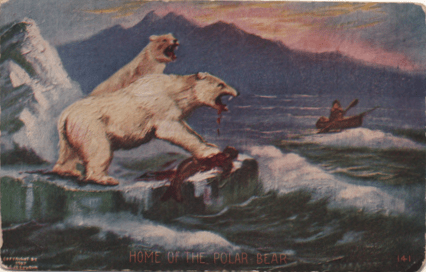
In the folktales of just about every group of people around the world, the Apex Predator holds a serious place. Whatever animal this is—the lion, the tiger, the wolf, the shark—is the supervillain, the great threat, the ever-present menace, the shadow in the wilderness (In fact, the traditional folk villain role was sometimes denied to the lion, which people could see napping in the sun WAY too often.)
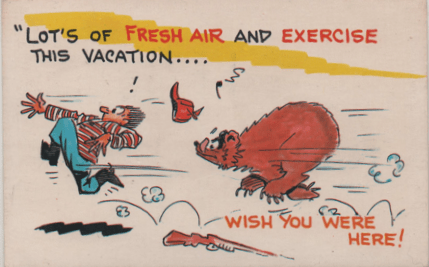
The bear, however, which is a big and powerful animal, and certainly willing to kill unwary humans who got too close, is almost never accorded that role. Part of the reason is that it had a power which had been denied to the tiger and the wolf. It could walk for long distances on its hind legs. Primitive humans were amazed and terrified by an animal more massive than they who could take on this human custom. It occupied a nearly unique mystic status; in Finland, for example, it was customary to perform a ritual apology to any bear you killed, explaining that it was not actually killed by YOU but by the Russians.

You don’t often see bears on their hind legs on postcards, but they DO spend a lot of time chasing unwary humans. This results both from the ferocity of the angry bear and partly because it was so easy to make puns on “bear”.

We have covered elsewhere the many, many postcards about people running off with a bear behind, so we will not repeat any of that here. Nor, by special request, will I tell any more variations on the classic joke about the preacher and the bear.

The role of bears in tales and on postcards is complicated, however, because of the fact that the bear is so dang cute. Okay, maybe this is not our best example.

Cute and kind of slow-moving, you see. So particularly as time went by, his role in stories became that of the Assistant Villain, the Apex Predator’s hired muscle, the strong enforcer who, on his own, thinks very slowly and is easily distracted.

This became further complicated after Teddy Roosevelt famously spared a bear cub while hunting, and became the namesake of the Teddy Bear.

In American history, particularly, you don’t see a LOT of stuffed wolf toys for children. Lions and tigers were kitties and cuddly and far, far away, but the wolf continued to be a menace on the verge of civilization. But bears were suddenly as cuddly as could be. (The gag here is that this bear is made of felt, and “stuck on tight” to the postcard since 1907.)
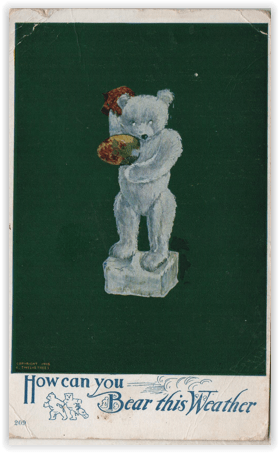
Bears were your friends, trustworthy in winter and summer. (A wolf would sneak up on you.)
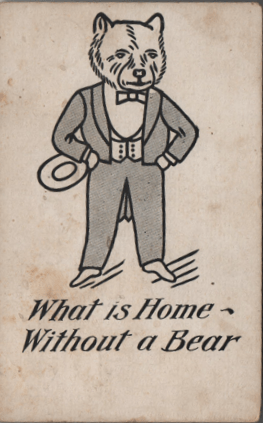
There were plenty of postcards which asked “What is Home without a Mother?” or “What is Home without a Father?” But you never saw a wolf on a card like that.
 Blogsy Babbles