
As usual, I was thinking about something else entirely, but that will have to wait until next week. Whilst going through my inventory to find illustrations for THAT notion, I came upon another subject to worry about.
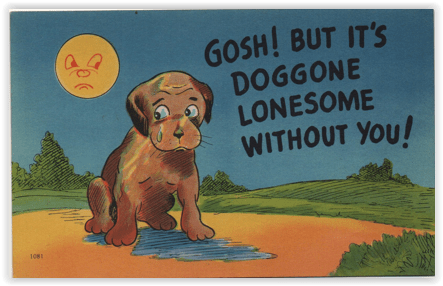
Postcards with dogs on them are always decent sellers: people do appreciate ‘em. A postcard publisher with lots of dog photographs will be guaranteed a goodly number of sales. And cartoonists who could draw cute dogs were a certain source of profitable jollity.
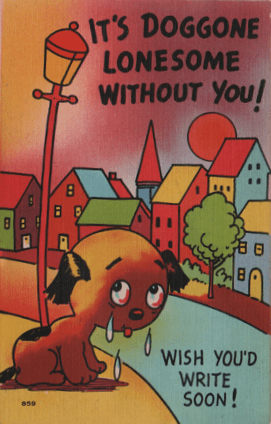
But a cartoonist can’t just draw a dog. There has to be an excuse, a caption, a joke or at least a mild pleasantry that requires the presence of a dog. Well, as many a cartoonist shows, the emphasizer “doggone” can be inserted into any sentiment to enhance the feeling.
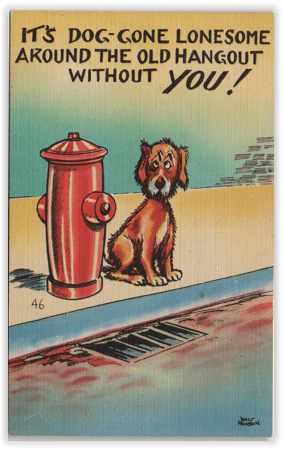
I was aware, of course, that the word is a euphemism, a substitute for something you might not want to be heard saying when Aunt Charity was making fritters. The English language is rich with euphemisms. Some people, wishing to condemn a group of, say, fleas which had jumped to them from their pet, could simply say “Condemn those fleas!” But that sounded too much like the word they WANTED to say, so they would scale back to “Confuse those fleas!” or “Concern those fleas!” Making fleas concerned was so popular that it became the “Consarn it!” now heard primarily in westerns. (Euphemisms like being transformed to get as far as possible from their obscene or profane origin. This never works: folks are hardwired to look for offensive things–we may, one day, spend a few paragraphs recalling how shocked some moviegoers were at Disney naming a character Jiminy Cricket, with even a song exhorting someone in trouble to shout…where were we?)

So, no matter how it is spelled (hope you noticed the disappearing hyphen in these examples) it seems that, as one online dictionary put it, “doggone” is simply a substitute for “damn”. (It is clearly meant as a synonym for “God damn”—two syllables and all that—but the online writer was also doing a bit of euphemizing. Some other day we may argue which euphemism is less logical “God darn it” or “Gosh damn it” I can argue either side.)

This was not enough for some other websites, which took the phrasing “doggone it” (note the different spellings of THAT) and derive it through “dadgummit” and “dadburnit” (interesting substitution of Dad for God, probably more a matter of sound than a consideration of God the Father) up to “God blast it” and “dadblasted” and thence to “God ro it” or “dod rot it”, which became “dadratted” in some places, and simply “dratted” in others. That’s a long way to go to get to “drat”.

That seems to me to be getting farther and farther from the dogs (in contrast to those who feel our language is going TO the dogs, but that phrase deserves a whole nother blog) and I am more interested by those who start with “dog garn it”, which they trace to England in the 1840s. Whether or not this is related to the exclamation “Garn!” which is a nasal contraction of a disbelieving “Go on!” I can’t say. And which came first in the world of euphemisms: “darn” or “garn”? Inquiring minds want an answer to this goshdarn question.

The matter cannot be discussed without a bow in the direction of H.L. Mencken, whose writings on the English language are on a whole different level from his article about Millard Fillmore and the first bathtub in the White House. (Untrue, but he made it SOUND so authentic.) H.L. Mencken derives “doggone it” from “dog on it!” a curse that was itself a euphemism for “A pox on it!” frequently heard in merry old England, but increasingly unpleasant as time went on for those who knew that the pox was a reference to syphilis, and that therefore a euphemism was required.
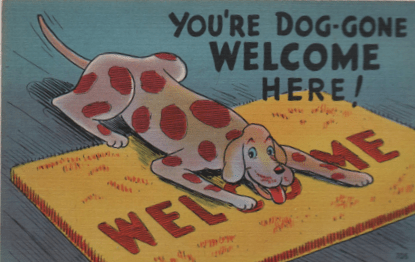
Maybe we could all just look at the cute puppies on the cards and settle for the online writer who simply defined “doggoned” as “a slightly old-fashioned substitute for ‘confounded’.”
 Blogsy Babbles