
If you have been following along (and why should you?) you will recall our discussions of the role of postcards in the life of the general public. Originally regarded as the text message of the day, they could be used to issue or accept an invitation, let someone know you’d gotten home safely, etc. This was possible in the era of two mail deliveries a day.
Gradually, the pictures became more and more important. A mere product is nothing without new and improved new improvements, and companies vied for great pictures, either things which told a story related to something the sender might be doing, or simply pictures of a place. These doubled as souvenirs for the buyer and advertisements for the seller: a description of the beauties of Zap, South Dakota might lure more tourist trade.
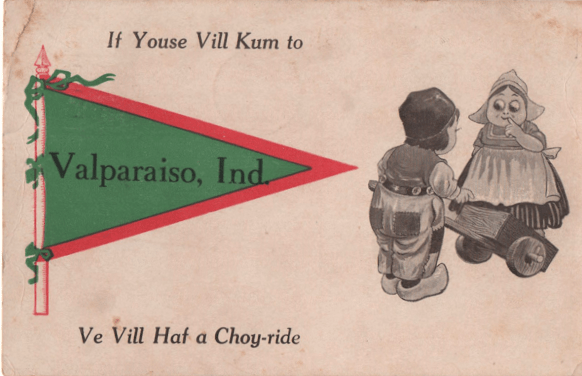
So, eventually, this being the world of commerce and marketing, some postcard companies tried to do both, producing funny postcards which had a blank spot where the name of a town (or, less common, a hotel or a resort or a beach) could be printed. This ALSO being the era when pennants for your wall were a major souvenir, this spot frequently took the form of a pennant.
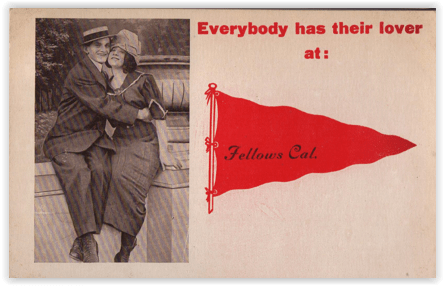
Any store that wanted to promote its community (as well as provide tourists with proof they’d been there) could lead through cards extolling the adventures a person could have, and order a few gross with the name of the town printed in. For a lower price, some companies would simply provide the blanks, and these could be taken to a local job printer for the same addition. (Not a GREAT job of centering here, but it serves its purpose.)

Here’s an example from World War I which has NOT yet been through the localization process.

How fancy these pennants became was limited only by the ingenuity of the seller, and the buyer’s desire to pay extra.
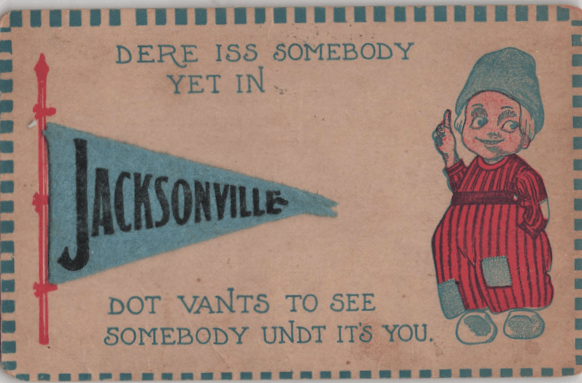
Look carefully at this item. See that the pennant has TWO points (which officially makes it a pennon or something instead of a pennant; missed that episode of Fun With Flags.) Actually, this was an extra deluxe item on which a felt pennant was pasted over the pennant blank on the card. The glue has just let go toward the end, so the felt point has drooped below the printed one.

If you look even more carefully here, you can see this one had no blank pennant at all, but DID, at one point, have a felt one, possibly removed to keep in a scrapbook by itself. (The white triangle shows that the pennant WAS there once, rather than this being another example of an unfinished card.)

Publishers were not limited to pennants for the purpose of adding a town name. Here, logically, they used a postcard on their postcard.

A newspaper was another useful prop.

As well as, of course, a camel.

This fashion started to wither away in the 1920s or thereabouts. Not that stores were uninterested in publicizing the towns they inhabited. But as far ack as the earliest days of the postcard, some companies would just print “Greetings from Elizabeth, Illinois” on any blank space on the picture. This was a lot easier, as it involved less alignment of the press and the picture. Still, some daring souls continued to use props well into the 1940s, using, say, a signpost.

Or a picture on the wall.
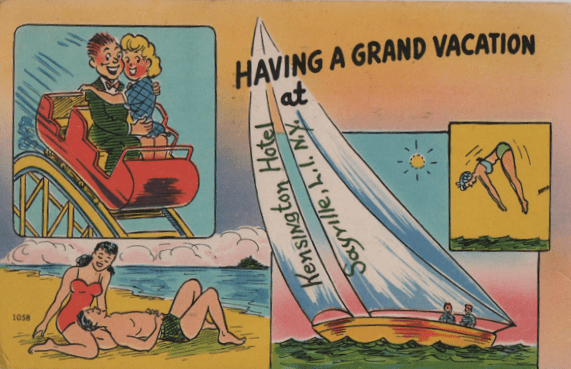
Or, adventurously, the sails of a sailboat.
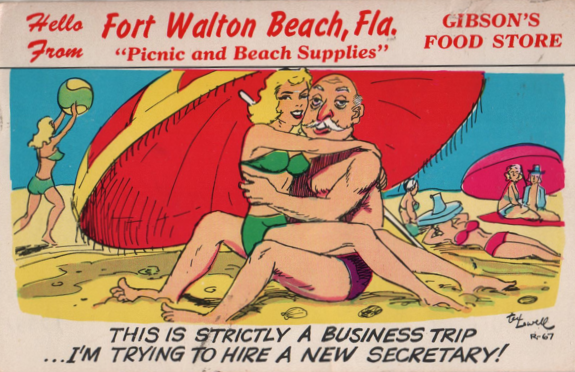
The postwar world, however, saw a decline in the use of postcards generally and, gradually, a decreasing interest in humorous postcards for local advertisements. For those stores which were still willing to offer more than just sunsets, autumn leaves, and sailboats to advertise, companies produced more cards like these, with a blank bar across the top or bottom with room for the seller’s address and ad. (They could also simply get a rubber stamp and stamp “Greetings from File’s Grocery” somewhere in the message section. But those folks, like the gentleman seen above, were really cheating.)
 Blogsy Babbles