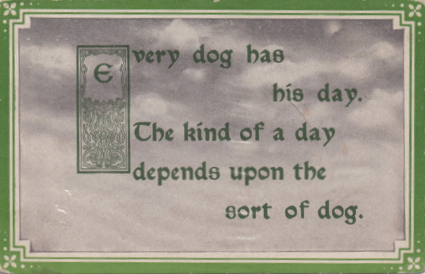
Proverbs are chunks of solidified wisdom handed down through the ages, a sentence or two which embody a nugget of truth. These may be cheerful “Every cloud has a silver lining” or cynical “Everything in the world is off by a quarter of an inch.” They can contradict each other: “It’s never to late to mend” and “A leopard can’t change its spots”. But they have been handed down to us through the generations because something in them was found useful.
AND they have been parodied and amended by people who simply cannot leave well enough alone. We have spoken hereintofore of the one at the top of this column, which still, to me, makes no sense whatsoever. In various forms, it has been around since at least the sixteenth century Exactly why someone felt they could make it better by adding…never mind. If I start frothing at the mouth, the dog catcher may take me away.

This, now, is simply a seventeenth century from the works of Alexander Pope, who actually wrote “Blessed is the man who expects nothing, for he shall never be disappointed.” The writer of this postcard has not tried to change the meaning; he’s just going along with a nineteenth century convention that true wisdom came from the mouths of people who didn’t talk English so very good. (Kin Hubbard, Josh Billings, and a host of comic characters were always saying wise things, but in bad grammar. See our discussions of Dutch kids postcards on how anything seems to sound new and interesting if said in non-standard English.) Many in the reading public would have taken advice from, say, Uncle Josh who would have disdained getting it from an English poet in a high wig.
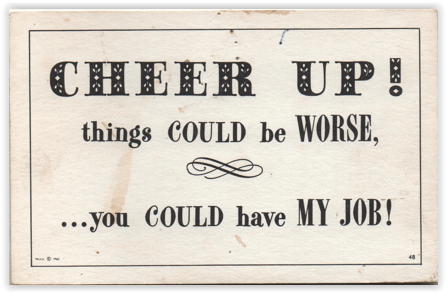
I am not even going to try to find out who wrote the original cheery note: it has been added to by so many disbelievers that all I will really find under “Cheer up: Things Could Be Worse” will be that fine old joke that was one of my father’s favorites. “They told me, “’Cheer up; things could be worse.’ So I cheered up and, sure enough, things got worse.”
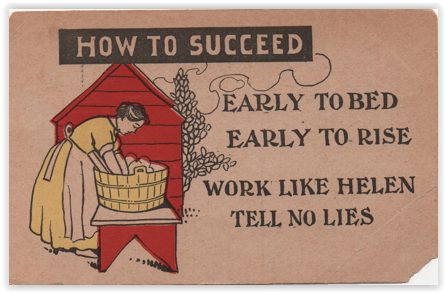
Here we are playing off of Ben Franklin’s frequently postcarded remark about early to bed, early to rise, makes a man healthy, wealthy, and wise. I don’t personally have any postcards with a more popular parody of this, “Early to bed, early to rise, makes your girl go out with other guys”.
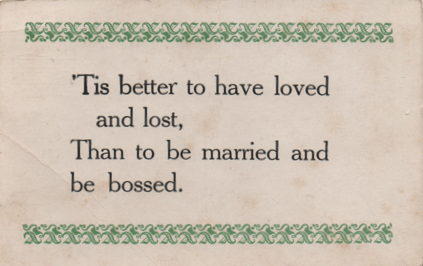
Similarly, this is one of the two most popular retreads of “’Tis better to have loved and lost than never to have loved at all”. (Alfred, Lord Tennyson, who wrote this in a poem to a friend who had died, actually wrote, despite all quotations of it “IT’S better to have loved, etc.”) The other popular retread tells us “’Tis better to have loved a short girl than never to have loved a tall.” This makes no sense, but it SOUNDS good. (And as Lewis Carroll told us, Take care of the sounds, and the sense will take care of itself. Which was a parody of another proverb, by the way. He did stuff like that.)
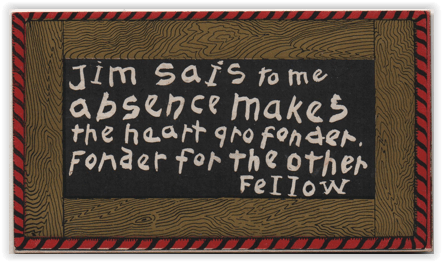
Variations of this sentiment have been around forever, but the experts are still chewing over where this phrasing comes from: most date it to something from the early nineteenth century. I would guess there are roughly half a hundred variations of it, including the rather suspect “Absinthe makes the heart grow fonder.” Do not try this at home.
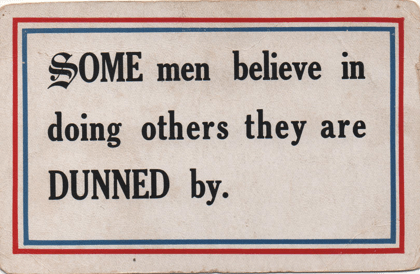
“Do as you would be done by” is probably the quickest version on the Golden Rule available. This variation depends on two archaic bits of wordplay: “doing” someone once meant to deceive or con them, while being dunned was to have someone demand the money you owed them.
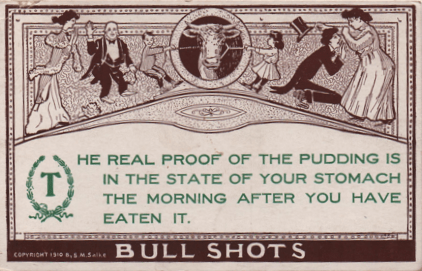
The original saying here comes from the sixteenth or seventeenth century, at least, and was popularized when an English translator put it in the mouth of Don Quixote. I think this parody does have a BIT of truth to it. Eating is just the start of the process. (Of course, we have a shorter version of what he’s saying: “There’s got to be a morning after”.)
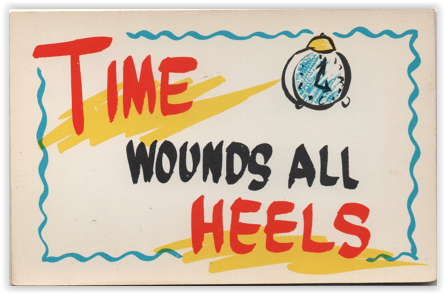
And then there’s this. The original seems to go back forever, with variations on “Time heals all wounds” being tracked to the fourteenth century in English, and a thousand or more years farther back in Greek. It’s a hopeful saying and, although this retread is cynical, well, once you’ve read the day’s political news, this one’s the height of optimism as well.
 Blogsy Babbles