
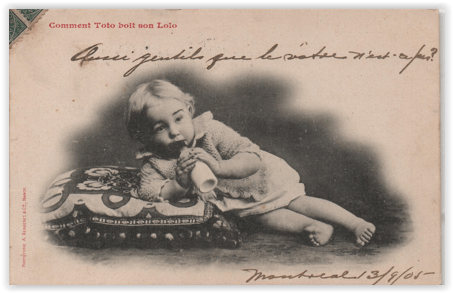
The recent addition to my inventory of a pile of postcards featuring babies made me wonder a little more specifically about a matter we have mentioned hereinbefore. Postcards of infants are filled with sociological observations, but most of those can be left to others, i.e., the proportion of mothers to fathers in baby-holding, the vying for prestige based on baby clothes and vehicles, and so forth. The thing that is really obvious at once is the variety of bottles used in days of yore to feed said babies. (An important job, as anyone who has ever listened to a hungry infant will testify.)
The “feeding bottle” can be traced to ancient Egyptian times in pictures and in actual surviving examples. Devoid of social and medical commentary, these ancient ones are most interesting for what they tell about human ingenuity, from hollowed-out animal horns to whimsical ceramic contraptions with an opening at one end for baby to get food and/or beverage (and THAT has varied over the years) and an opening at the other where the feeder could control the flow by putting a thumb across the intake.
Commercial products, which have the advantage of attached advertising hype, seem to begin in the seventeenth or eighteenth centuries, and grew more numerous in the nineteenth century, when the age-old alternative of simply hiring a young woman to breastfeed (a wet nurse) became suspect. A number of these went for a breast-shaped design, as something baby would recognize.

But what a lot of people wanted was something baby, having reached a certain age, could handle all alone. This design, with the feeding tube, is seen on a lot of postcards. The secret of its popularity between 1890 and 1910 comes from two factors: it was relatively cheap (you could buy the tube and attach it to any empty bottle you had at home) and if little Bubble would cooperate, you could leave it on a table, shove the nipple into Bubble’s mouth, and do something else while Bubble had lunch.
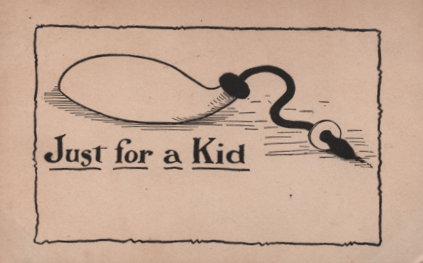
Some babies really took to this, finding that long handle easy to pay with. This did not speed up lunch, and needed to be discouraged (so Mom or Pop couldn’t go TOO far away during feeding.)
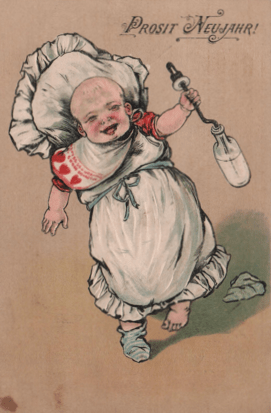
Modern eyes are not accustomed to this design, hence the inclination in sales listings of such pictures to label them “enema bags”. Other viewers wonder how on earth Mom or Pop could wash the milk out of such a long tube. The answer, briefly, is that they couldn’t, and didn’t, leading this popular design to be labeled, by intolerant later generations, as “the murder bottle”. Some of these gentry have gone so far as to crunch the numbers and find that the infant mortality rate actually rose for several years. This design started being banned around 1910, and had lost its spot in the market by 1920 (the usual reaction of consumers to an announcement that a product isn’t safe: I wonder why it only took ONE decade.)

What replaced it was known, as you could probably guess by looking at it, as the “banana bottle”. Note the simple design: intake valve and filling hole at one end, nipple at the other. (The design and construction of nipples is a whole nother story; you may imagine for yourself what Junior’s reaction in the nineteenth century was to Victorian nipples made of rubber with a strong smell of sulfur.)
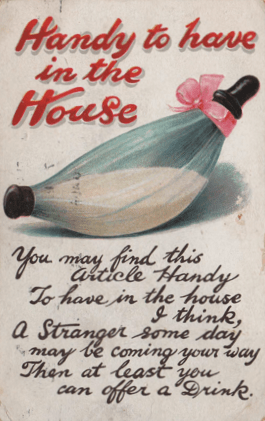
As you can see here, this was a design that little Thimble could hold all by herself (if the opening at the back was properly closed). You can also see how the joke about Thimble and her Daddy both hitting the bottle is as common as babies and fine old jokes.
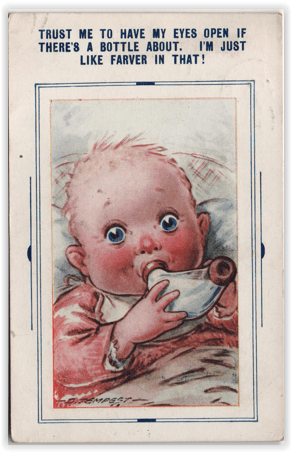
The cylinder shape most of us are familiar with from the late twentieth century was easy to construct, especially once plastic started to replace glass, and even when glass was promoted as the easiest design to wash and sanitize. (It was also easiest to fit with a disposable plastic liner, which was also supposed to limit how much air Blossom sucked in with the milk or formula; the banana design was also promoted as assisting in this anti-colic feature.)
In the twenty-first century, of course, we have the medical profession coming out in opposition to ANY design of bottle, as they hold breastfeeding to be the optimum service to little Bimble. This might revive the profession of wet nurse, or, of course, other traditional baby feeding methods.

 Blogsy Babbles