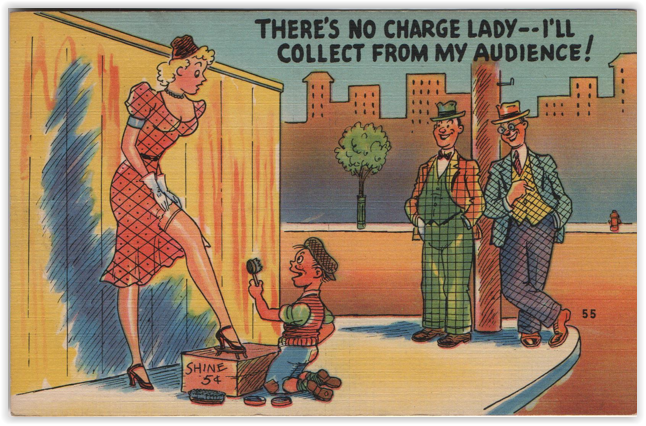
We have been discussing stockings worn by ladies on postcards of the past. I mentioned that in this, as in so much of a cartoonist’s life, what is really important is knowing just where to draw the line. And so today, we are going to discuss stocking tops.
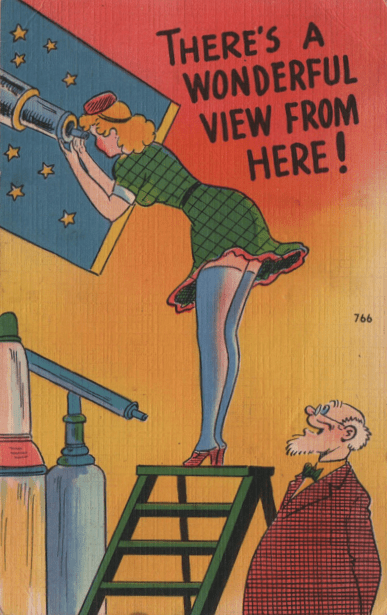
Maybe this is what is meant when the self-appointed experts on the Interwebs insist that women’s stockings were of no great interest before the invention of the nylon stocking. At any rate, it DOES appear to be about now that cartoonists really utilize the stocking for what sociologists have been claiming the leg does as an erogenous focus. It draws the eye upward.

We saw stockings in the pre-nylon postcards, but not very many garters. NOW the garter and the top of the stocking are an essential part of the design. They emphasize that little patch of bare skin showing above the stocking. This made the picture appealing to more than one audience. Those fascinated by pictures of stocking had long stretches of leg to examine, but the stocking top was there to remind the others that the artist knew there was more to life than a stretch of fabric.
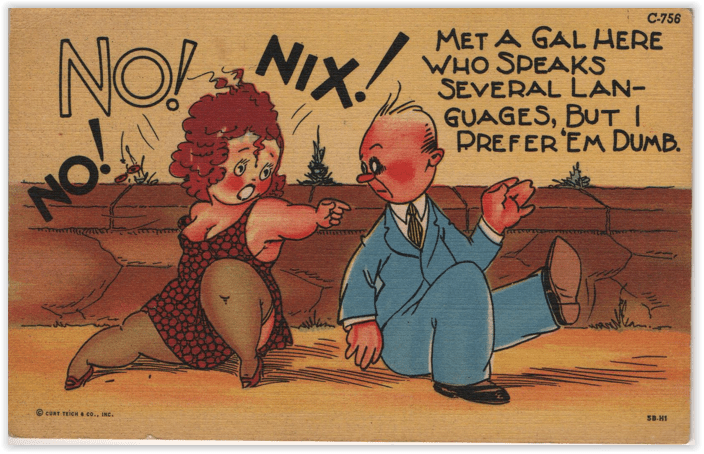
And this may be why you also see very few flesh-colored stockings in these postcards. The contrast made it clearer what the viewer was seeing (and what the viewer did NOT get to see.)
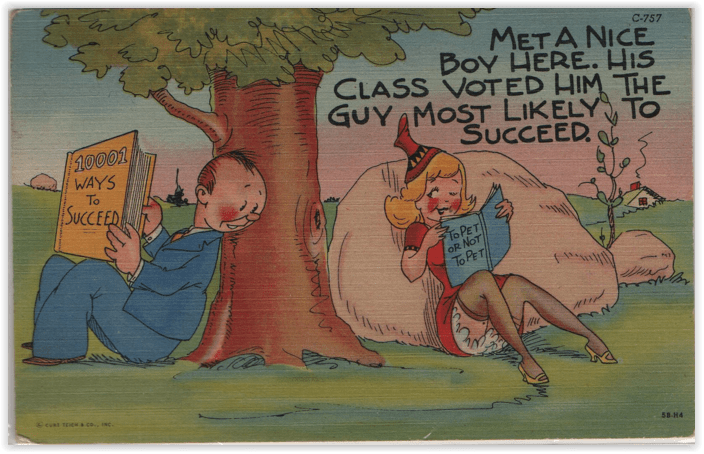
Raymond Chandler, inspiration for so many hardboiled detectives in book and noir motion picture, had his detective refer to the long legs fashionable in the era as a race track which led to the finish line.

Benny Hill, less noir, simply noted that the good thing about stockings was that no matter how long they were, the top was always near the bottom.
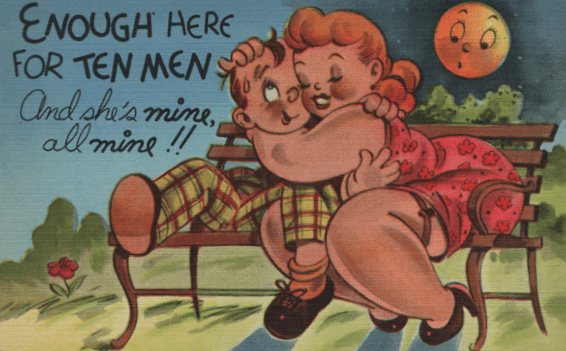
This, some experts have claimed, is what made the garter and/or garter belt such popular erotic icons. They dented the flesh at key points, emphasizing the nature of what they were up against.
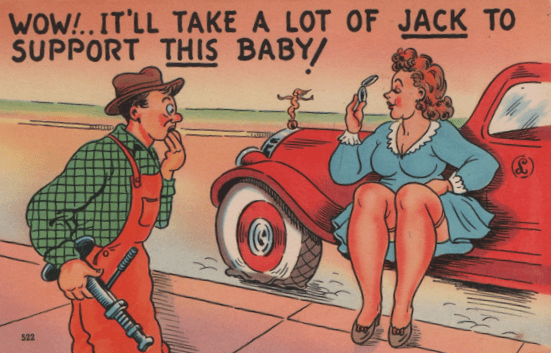
Some cartoonists found them unnecessary, preferring to imply texture with line alone.

Not to claim that these are the more subtle cartoonists.
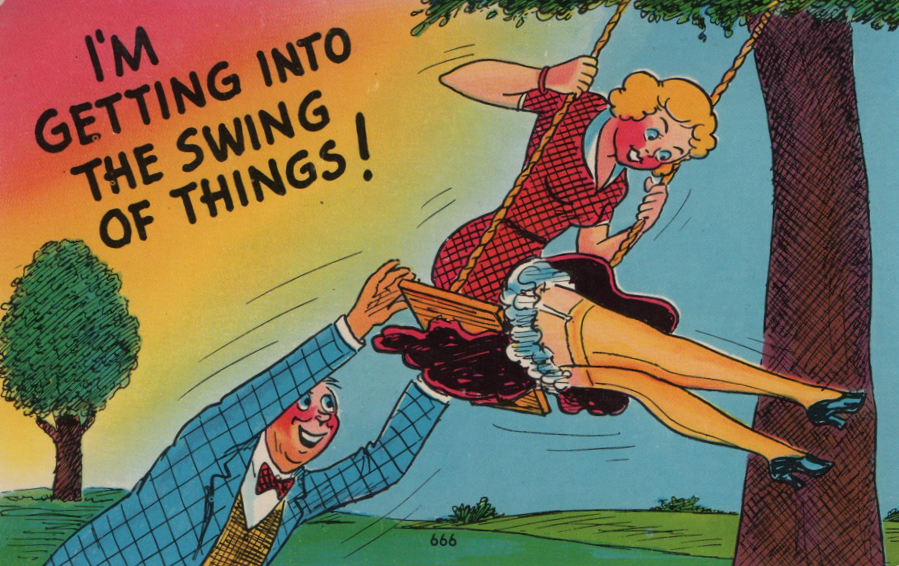
The cartoonists, at least the ones included in my inventory, did not include EVERY feature of the stocking which attracted viewers of the day. This, for example, is the only card I’ve noticed which emphasizes the seam at the back of the stocking (memorialized by songwriters and comedians in days of yore; these replaced the jokes about the “clocks” on pre-nylon stockings, which on postcards frequently have mice trying to run up them. This seam was already important enough by World War II that when nylons were rationed, and some companies sold a nylon-colored leg paint to take their place, women were urged to take an eyebrow pencil and draw in the seam, which no doubt resulted in a lot of improbable seam work until the skill could be mastered.)
But enough of thighs and thigh-high stockings and garters and such. We can now move on and apply our mind to higher th…yeah, let’s just tiptoe out of here now.
 Blogsy Babbles