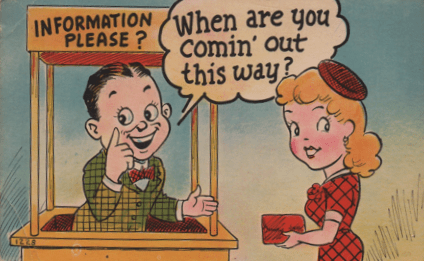
It has been a while since we considered postcard gags helped by historical background, and as I have recently been stumped by a couple, I figured it was time to bring up the matter again. Spoiler Alert: for once, I think I have no postcards to show you which are based on Bert Williams records. He’ll be back.
Some of the background will not materially affect your appreciation of the joke. The postcard at the top of today’s adventure is perfectly comprehensible even if you don’t know that once upon a time you had to get someone’s phone number by calling the operator and requesting “Information, please”. This phrase in turn became the name of a wildly popular game show where the audience would send in trivia questions in hopes of bewildering a panel of experts, who acquired a reputation for omniscience. Guest panelists, I am told, included Dorothy parker and Boris Karloff, which provokes all sorts of questions I’d like more information about.
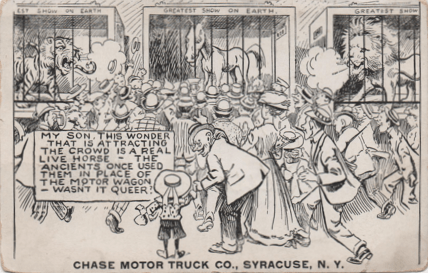
This gag was omnipresent in the first generation after the invention of the automobile, and is not necessarily enhanced by knowing that the truck company that put it out was a leader in inventing multi-purpose vehicles: cars, for example, which could be converted into trucks, ad is now considered one of the rarest of American motor companies as, despite having produced vehicles for over a decade, only forty or fifty of these still exist. Horses are still in the majority.

The older members of the audience may not need to be told that in ancient times when you took a photograph, it had to be DEVELOPED, and what you got first was a NEGATIVE. So…. And no, I don’t know whether the odd proportions of the people here are part of an individual style or a reflection of the fact that a lot of artists who might have been doing postcards had been drafted to serve in World War II.
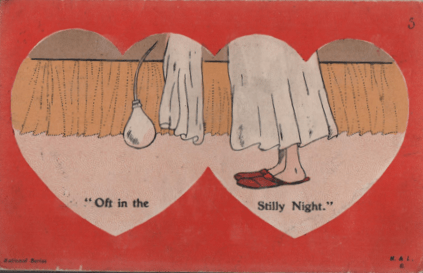
This gag, besides expecting you to be familiar with the song known by this title, relies on you understanding that this is a parent feeding a baby in the middle of the night. Few of us now dress our tots in these long nightgowns, and this particular design of baby bottle disappeared long ago. I am tired of seeing listings of postcards which describe this as enema equipment. The baby bottle once operated on a similar principle: if you get the liquid running fast enough down the tube and aim it at the sweet spot at the back of the throat, Baby will have to swallow what’s coming down whether it’s apple juice or rhubarb extract. Of course, if you miss that spot, you’re going to have a choking, irritated infant, and…yeah, we gave up on that technology.
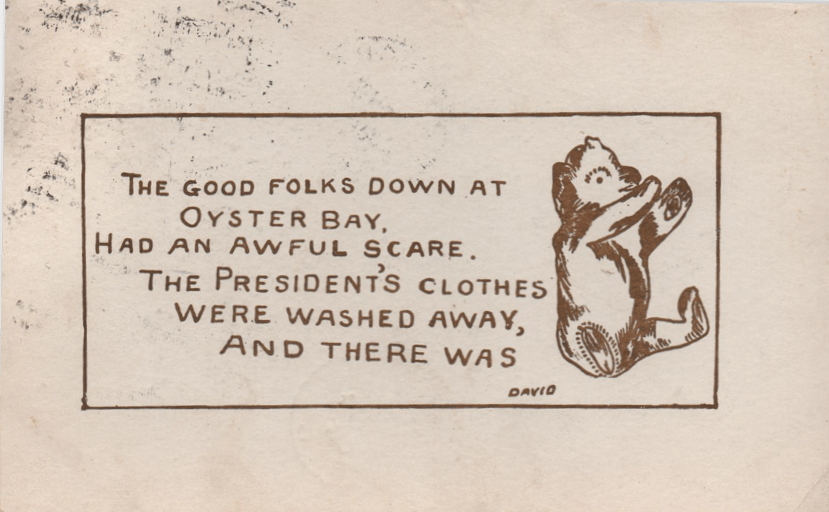
Certain towns and resorts have been famous (infamous) as Presidential retreats: San Clemente, Kennebunkport, Mar-a-Lago are just soe from my own time. This one came out in a day when EVERYONE knew Teddy Roosevelt would retreat to Oyster Bay when he wanted to get away from the White House. If you know that, then you see where we’re going with this gag.

Here’s one of my stumpers for the week. This slang expression appears on other cards, and seems to mean the person is a mover and shaker in society and/or business (the joke is one of contrast.) But I have searched the Interwebs in vain for any confirmation of the phrase to no avail. Maybe the expression faded too quickly; “push”, by the 1920s, was used to mean drive, motivation, the need to exceed, and has pretty much stuck to that since

But this gag is the most devastating of my research failures. All I could turn up was another postcard of roughly the same era in which a mixed quartet sings “How dear to our hearts are the beans of OLD Boston”. This parodies the opening line of “The Old Oaken Bucket”, a song standard for more than a century (with an interesting history of its own, as the melody was composed for an entirely different song, and….) Anyway, after mocking the line “How dear to this heart are the scenes of my childhood”, the song MUST have gone on. Something about beans seems to inspire music (wait, let me…no, let’s pretend that didn’t happen.) But I cannot find anyone anywhere who mentions the rest of the lyrics. Half a dozen songs exist about beans and Boston, and googling the phrase “Boston baked beans” will turn up almost as many songs as recipes. And there are several parodies of The Old oaken Bucket extant (one about the unhygienic nature of wells and buckets and another by the mighty Nat Wills about what happened when he bent to drink from the bucket and exposed the red patch on his pants to a bull in the field.) And yet, in a medium where you can find multitudes chiming in on the proper lyrics for “The Eensy-Weensy Spider”, the Beans of Our Boston have eluded notice.
I’m sure it’s just a matter of time. I’ll keep you posted.
 Blogsy Babbles