There is occasional confusion online between the 1922 “Scrooge” and the 1923 “A Christmas Carol”. Each was made in England, and each was part of a longer series of films based on literature. The Gems of Literature series ranged farther afield in its sources, including Shakespeare and Edgar Allan Poe. If you go hunting for it, this version is the one which starts with what LOOKS like a quote but is not.
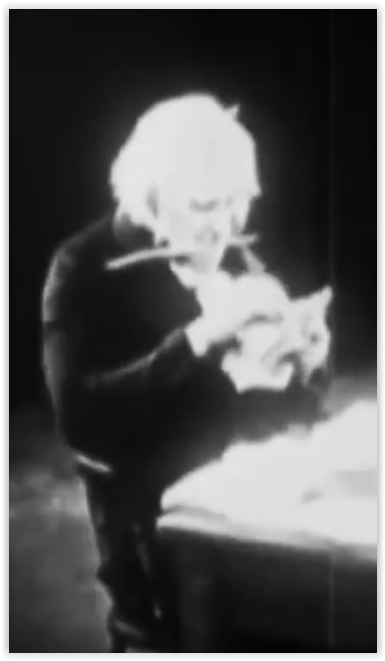
“Wise men have always contended that the toughest skin that covers any animal os tp be fund on that of a miser.” After this dubious assertion we are told that we will see a squeezing, wrenching, etc. old sinner. We are over a minute into the movie before we finally get to see a white-haired man, the “surviving partner” of Scrooge & Marley. He sits at a cluttered desk, riffling through documents as he holds his quill pen in his mouth, with somehow enhances his Scroogeness.
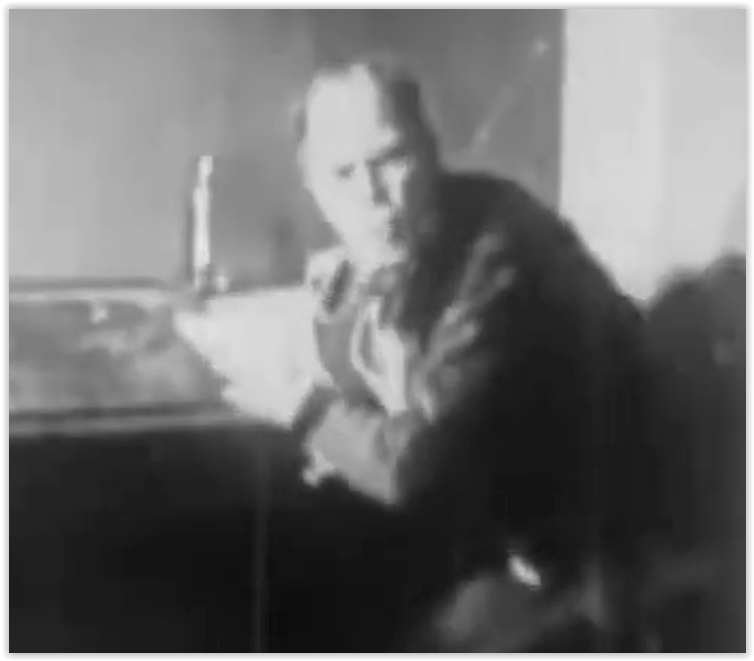
When he glances over his shoulder, we get our first look at Bib Cratchit who, as in the novel, works in a “dismal cell” off the main office. It is clear from the way Scrooge does this that he is in the habit of checking to make sure his clerk is busy. Cratchit tries to slip out of his cluttered cell to add some coal to the fire (which is in the boss’s part of the office. The attempt fails, as usual, and we see through the window that someone is approaching.
Fred is a cheerful and fashionable (look at those points on his lapel) soul who slaps his uncle on the back maintains his spirit even through his uncle’s remark that the idiots who go about with Merry Christmas on their lips should be buried “in a holly through his heart.” (Scrooge is upset enough to get the line wrong.) Fred feels Scrooge is miffed because his nephew married for love and now becomes a little fierce. Scrooge tries to shoo him away, but he persists with an invitation to Christmas dinner. Scrooge rises to reinforce his “Good afternoon”. Fred, a little resentful, does take his leave, pausing to offer one last “Merry Christmas” and throwing up his hands when this is rejected. On his way out, he raises his hat in a cheery wave and a Christmas greeting for Bob Cratchit.
Bob, who has been making faces all through the previous conversation and looking as if he’s ready to come out fighting on the behalf of Fred and a merry Christmas, responds with a call and a wave of his own. This obviously makes Fred feel better, but draws the wrath of his employer, whose bark makes Bob huddle over his desk again. Meanwhile, we follow Fred outside, where he digs deep in his pocket to give a coin to a ragamuffin who next positions himself in an archway which must lead to the offices. (Though we do not see a window). Here he clearly sings at the top of his lungs until Scrooge charges out and knocks him down with a ledger.

Another figure can be seen through the window when Scrooge sits down at the desk again. Scrooge orders Cratchit to open the door, so THIS visitor apparently knocked first. Cratchit admits a tall prosperous chap in a coat nearly as fashionable as Fred’s. The visitor inquires whether he is speaking to Mr. Scrooge or Mr. Marley, allowing Scrooge to remind us that his partner is dead. The visitor is woeful at this revelation, but goes on with that under-appreciated line about Marley’s liberality being well-represented by his surviving partner.
Scrooge, not having realized his visitor’s purpose, invites him to sit down. The two men now, in alternating close-ups, demonstrate Scrooge’s basic nature, Ebenezer enjoying his own jokes more and more as the Charity Solicitor grows increasingly earnest. (Bob, meanwhile, is trying to keep his hands warm…to reinforce the visitor’s point about the poor and destitute AND his employer’s apathy about them.) Scrooge finally, with great glee, pounds the desk and cries “Not one penny!” before wishing his visitor a “Good afternoon” with a triumphant smile. The Solicitor, outraged, takes his leave.
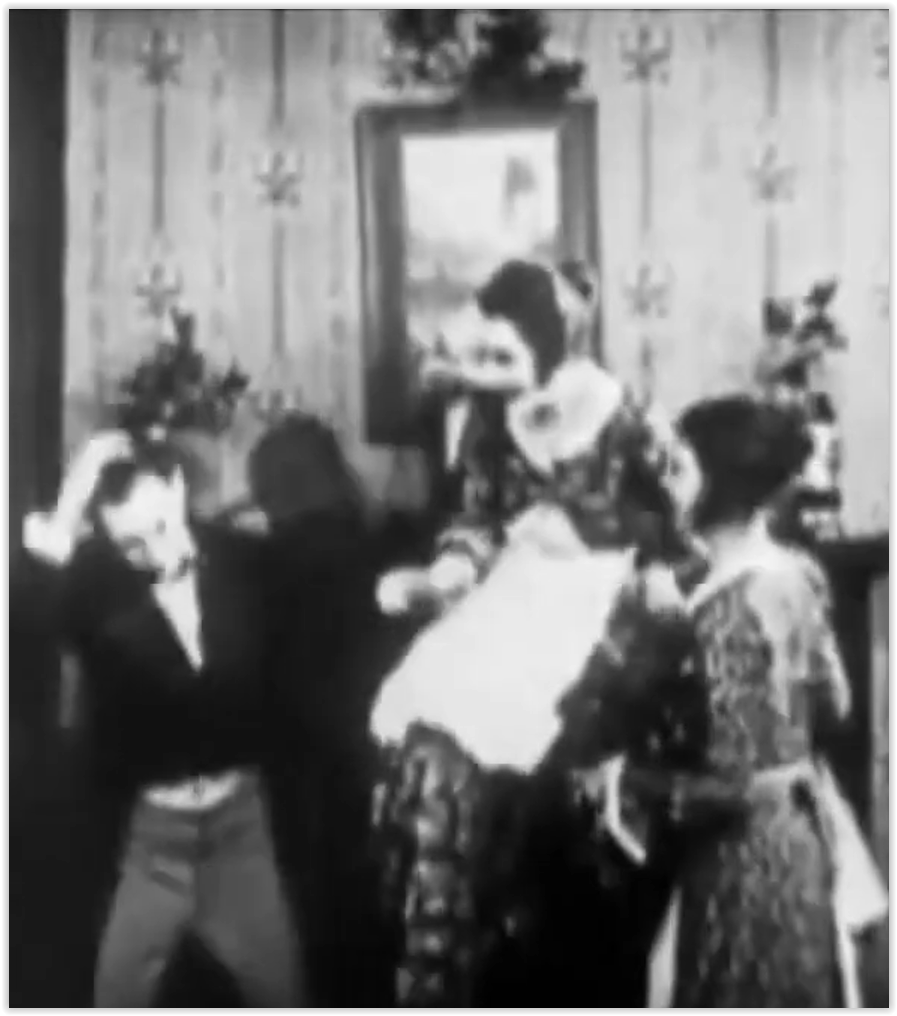
We now cut to “Ms. Fred and her sister” who are decorating a cheerful room with greenery for the holiday. Mrs. Fred is the one on the ladder, since when Fred comes in, he teases her by shaking the ladder (which she is sitting on, so there’s no real danger.) They have a mock fight, though Fred seems to feel she has grabbed his hair too energetically. He admits he is miffed because Uncle Ebenezer refused to come to dinner and said Christmas was a humbug. The two ladies see, genuinely disappointed, but their indignation over Uncle Ebenezer’s attitude makes him feel better.
We return to the office. At closing time, Bob and his employer have that exchange about a day off, which Scrooge denounces as “Christmas humbug!” Scrooge departs and Bob, making sure through the window that the boss is really gone, gleefully rushes to get his own coat. (Is that clock pointing to 7:50? Is Bob riotously closing up ten minutes before his time?)
Jumping right past the doorknocker and the stairs, we find Scrooge in “his own gloomy room” where he is brooding “over the stupidity of Christmas festivities”. This is shown by his rubbing his hands and saying “Humbug” before he reaches for his gruel. A ghostly man walks unannounced through the door. The apparition announces he was Jacob Marley. Scrooge goes through an array of reactions as the conversation goes on: you can see he believes, doubts, is frightened, is encouraged as he declares his liver must be out of order and Jacob gets all of Dickens’s lines in quite the wrong order, announcing the visit of three spirits before he demands whether Ebenezer believes in him or not. Marley is quite a solid ghost, looking more healthy and hearty than Ebenezer, and not the least bit frightening until, objecting to that joke about gravy and the grave, he throws up his arms and advances.
Scrooge drops to his knees and is treated to the long speech about the chain Marley forged in life and regrets about never taking an interest in that blessed star. Scrooge is impressed by all this. (Did they argue this way in the office when they were both alive?) They eventually get back to saving Scrooge through the visit of three spirits. Scrooge buries his head in the chair and Marley vanishes. Scrooge then eyes his gruel suspiciously, still ready to blame his liver, and asks why spirits roam the earth.
He has been feeling chilly all evening: now he pokes up the fire and turns to find a ghost no taller than his table. This reinforces what Jacob said, and Scrooge rises, frightened, to ask who the new visitor is. The Ghost of Christmas Past introduces himself, they exchange the remark about “Long past?”, and then the Ghost orders Scrooge to “Behold the girl who would not marry you because your heart was obsessed by love of Gold” before putting on his cap and disappearing. Scrooge rubs his eyes and sits down. The scene appears: his girlfriend looks as if she is sitting on the current Scrooge’s table, with the young Scrooge and another fireplace beyond. She is exceedingly upset, and very dramatic in whatever she’s saying to Scrooge (the Ghost has already told us, so there are no title cards to interrupt her performance.) The current Scrooge remembers it, and is very upset. His state of mind is not improved when the little ghost reappears to taunt him, pointing out that Scrooge has lived alone with his gold when he and she might have been so happy together. Scrooge, arms flailing, orders the Ghost to haunt him no longer, and when the little prig vanishes, pronounces it all humbug.
Scrooge turns to find his fireplace blocked by a massive Father Christas, flanked by trees (all transparent). He finds this ghost much more pleasant, rubbing his hands and holding them up to be warmed by the presence. The spirit has come merely to warm Scrooge’s hands and then refuse to stay, in spite of Ebenezer’s entreaty, because he only visits those who love Christmas; Scrooge, who loves himself, is not eligible. The self-righteous giant vanishes, despite Scrooge pleading that he is not the man he was. Weeping, Scrooge totters toward the door.
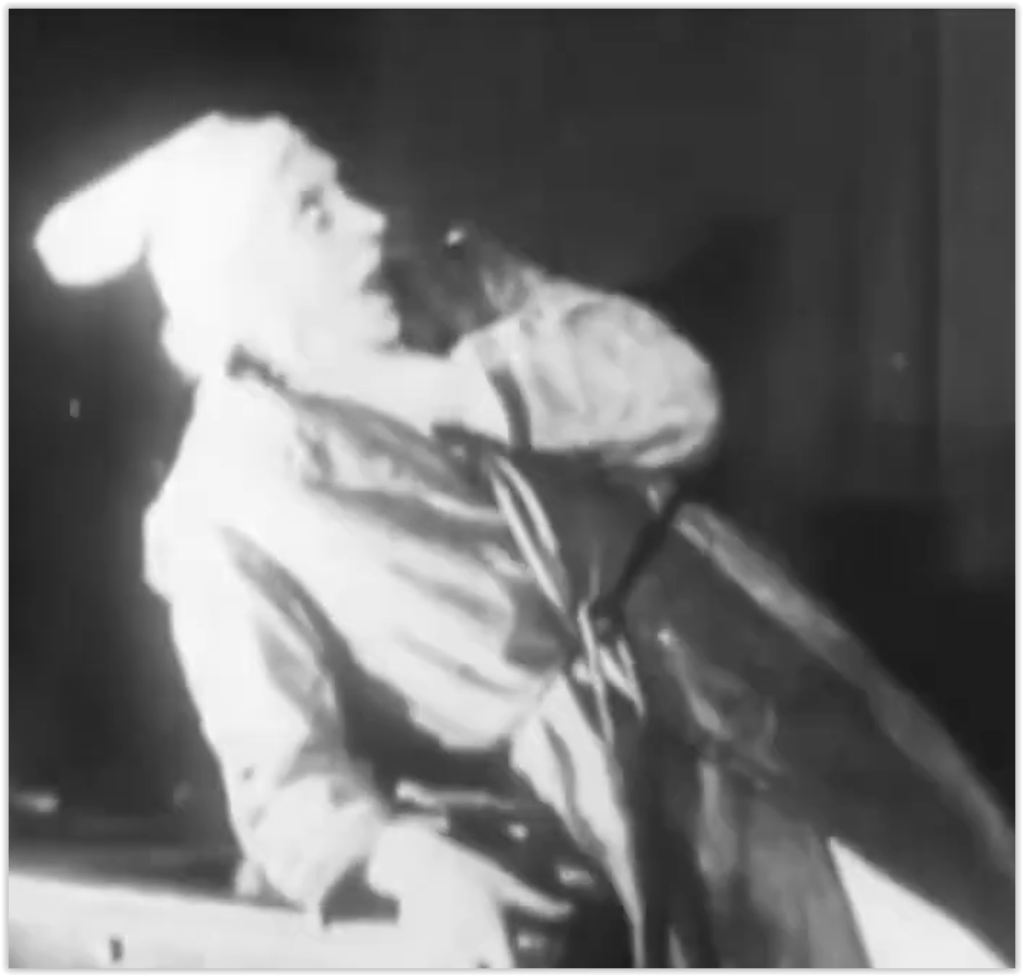
A robed character enters, announcing itself as the Spirit of the Future (no Christmas.) Scrooge whose acting has not been terribly restrained so far, now becomes an out-take from Nosferatu, his eyes bulging, his hands clutching at his throat. The Spirit steps out: one long white hand stays to beckon. Scrooge is drawn to the door, trying to hold back but dragged by a powerful force outdoors, where the Spirit stands over a tombstone flat on the ground. There is a low stone tomb handy for Scrooge to sit on while he tries to avoid looking at what the Spirit wants him to see. Scrooge wants to be assured that these are the shadows of tombs that MAY BE only. The sight of his name horrifies him, and he grips his head so fiercely that he knocks his cap off. He begs for a chance to sponge away the writing on the stone, and the Spirit vanishes. Scrooge weeps into his hands.
His face is still buried in his hands when we see him next, sitting in his chair by the fire. He sits up and realizes where he is (not even amazed that he has his cap on again). He touches the gruel pan and the fireplace for reassurance, concluding that the shadows of what would have been may be dispelled. He is thankful on his knees for this, and we cut to Fred’s house.
We now introduce Topper, who is proposing to Mrs. Fred’s sister in the dining room. Mr. and Mrs. Fred, who are just trying to get the meal on the table, understand, and hold back (though Fred is carrying a heavy tureen) until Fred sneezes, alerting the now engaged couple to his presence They rush in to congratulate Topper and the soon to be Mrs. Topper. Fred closes the door, perhaps so the servants won’t see, or to shut out a draft, and certainly not to set up the next scene.
For his uncle appears, assuring the servants (whom we never see) that it’s all right. He thinks about entering, but Mrs. Fred is saying grace, which makes him pause and almost turn away. When he enters, to the apparent joy of Mr. and Mrs. Fred (the other two, who apparently have never seen him before, are simply surprised), Mrs. Fred grabs another place setting, while Topper grabs a chair. Scrooge then takes out what seems to be a large wad of money and forces it into Fred’s hand. After wishing Fred a Merry Christmas, he is kissed several times by Mrs. Fred and then dragged to the table where Fred reveals the steaming soup inside the tureen.
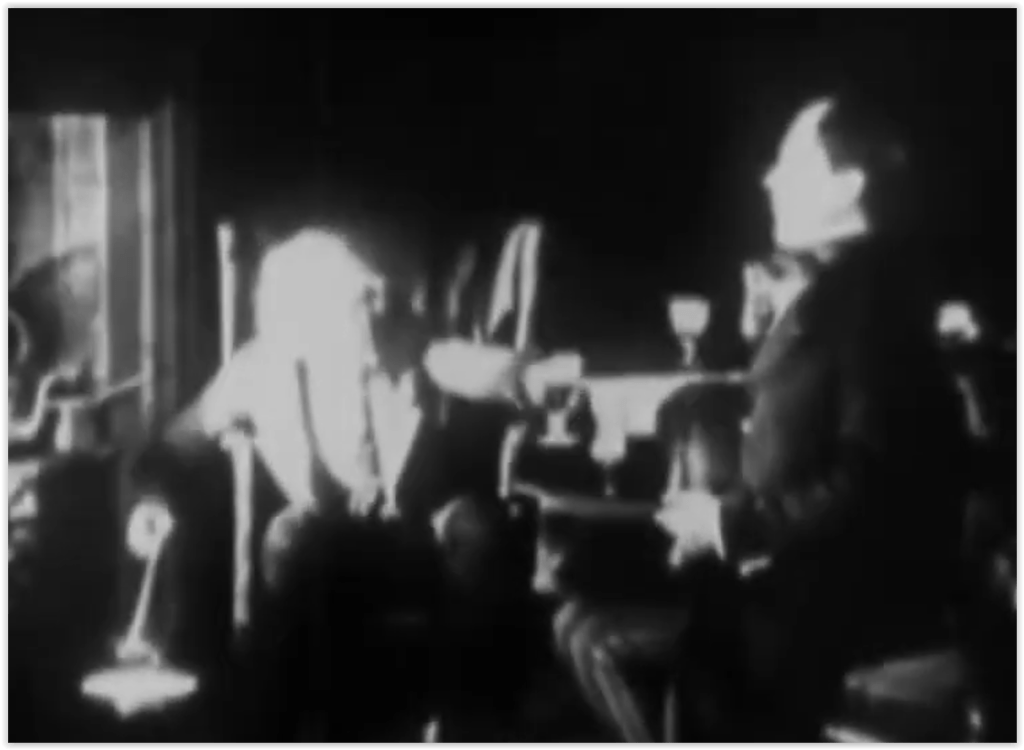
We are told that Scrooge finished off his first REAL Christmas by sending for his downtrodden little clerk. We are once again at Scrooge’s own fireplace where he, he the Scrooge, himself, serves Bob a glass of hot punch. He then gets himself a glass and announces he is doubling Bob’s salary. They touch glasses and raise them to Scrooge’s declaration that he is as happy as an angel, as giddy as a drunken man, and so forth, all the way through Whoop! Hallo! The End.
This movie is twice as long as the 1922 fragment, but does away with even more. Not just Tiny Tm but the whole Cratchit family is gone, save Bob. The poor caroler who was knocked down never gets to fetch a turkey, the Charity Solicitor is not given money, the Ghost of Christmas Present has nothing to do but lecture. The Fezziwigs and the ragpickers and many other side issues must wait for another movie. More of the original text is here than in previous versions, mainly because there are way more title cards, and the screenwriter has sort of tossed these into the air and let them fall into the story wherever he saw fit.

But it would be unfair to be hard on the 1923 “A Christmas Carol” (at least it reverted to the original title.) The surviving print is not good, and Scrooge (Russell Thorndike) and Bob Cratchit (not even billed) have mobile faces, when we can see them. (Thorndike makes Scrooge especially loathsome in his discussion with the Charity Solicitor—also not billed.) The producers apparently felt this was Scrooge’s story first, and Fred’s second (Fred and Mrs. Fred ARE in the credits, along with the solid and unfrightening Jacob Marley.) Perhaps there is some genuine influence by Nosferatu: there seems to be an attempt to make use of shadows (again, in this print it’s hard to tell.) As for the re-ordering of Dickens’s text, well, there are plenty of sound version which have done more (Mr. Magoo changed the order of the very ghosts, after all.)
And it does help explain why the early sound versions…but we’ll save that for next time.
 Blogsy Babbles