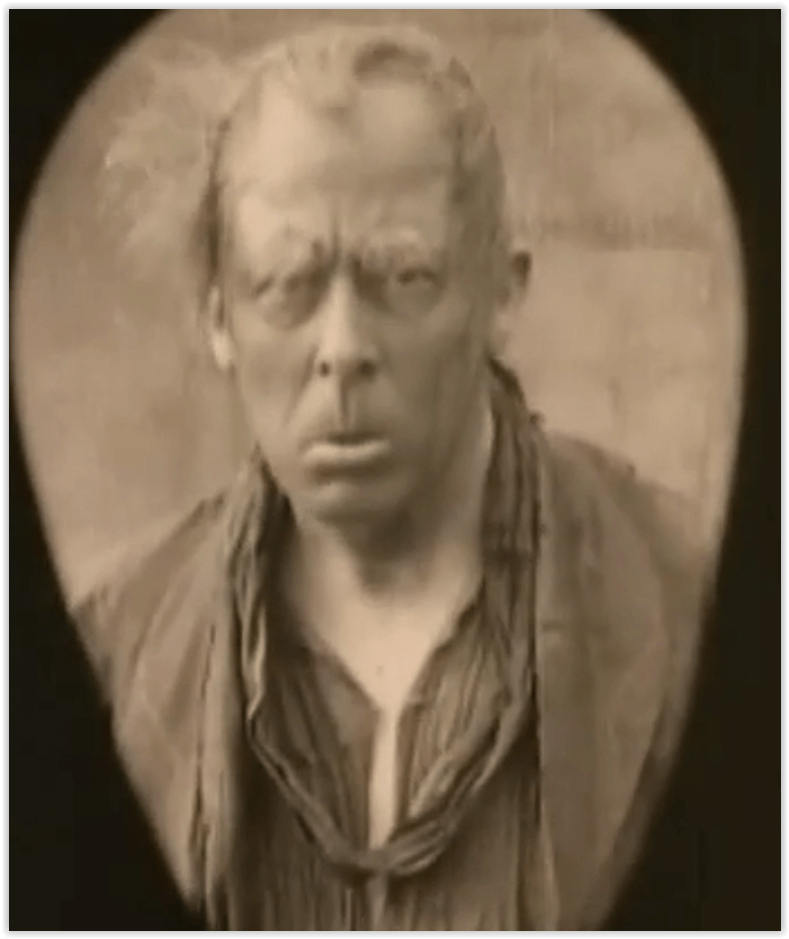
“Scrooge”, rereleased later as “Old Scrooge” for no apparent reason, appeared in 1913 and was the longest (known) version of the story up to that time, clocking in at some forty minutes. It opens with a little pseudo-documentary beginning with shots of Charles Dickens’s birthplace (with people pointing at it in part so we know this is not just a stil picture) which relates the plight of the Dickenses to that of the Cratchits. We then see Charles Dickens pacing a little in a book-lined study before sitting down to write “A Christmas Carol”. This Dickens is the bearded version, though I believe that in 1843, the real Charles hadn’t grown the beard yet. However….
We are finally introduced to someone who looks like he just got out of prison and needs a bath. He limps through the streets of London as though walking is difficult. If you look closely, you may recognize Sir Seymour Hicks, who had been playing Scrooge on stage for a dozen years at this point and would reprise the role in 1935 as the first talking picture Ebenezer. This Ebenezer, referred to by one critic as the dirtiest Scrooge in cinema, is not a terror to EVERYONE, as we see him pelted with snowballs by children (“though of course they shouldn’t”, the title tells us.) When he gets a little peace and sits on a snowy bench to read his account book, we understand at once that he has done this so the children can regroup and jeeringly wish him a Merry Christmas, allowing him to deliver his first thoughts about the holiday. His apparent difficulty walking reappears as he goes to his office door. Behind this are steep and inconvenient stairs up to a wood-filled and cheerless office. Meanwhile, Bo Cratchit, carrying Tiny Tim, has made his way to the same door. He sets Tim down and sets him to walk home alone (different movie). Blowing kisses to his son, he is snarled at by Scrooge through the window that it’s time he was at work. After Bob hurries inside, we watch Nephew Fred approach, “poor and carefree”, and spot the “carolers” (those kids have done no singing up to this point and are now tossing around handfuls of flou…snow) and gives them all his money.

Fred and Scrooge have their scene together: Fred seems shocked to find his uncle unmerry, and Cratchit rises to show him out long before Fred is ready to go. Bob then lets in a poor woman begging for money so Scrooge can tell her off, using both the “poor excuse for picking a man’s pocket” line AND the “decrease the surplus population” one. Bob tries to give her some money quietly, but she gives him away by kissing his hand, allowing Scrooge to threaten that Bob will keep Christmas by losing his position.
Cratchit makes matters worse not long after that by trying to replenish the fire and is told not to waste coal, as the chill will make him work faster. And NOW the charity solicitor comes in. Presumably whoever put this version together wanted a lot of little short scenes and speeches, because otherwise there was no reason for the begging woman at all. (Maybe they just needed one more female character; somewhere in the cast you will find Ellaline Terriss, Sir Seymour’s wife.) On leaving, the solicitor shakes hands with Bob, which sends Scrooge into another rage, allowing him to do the “all day tomorrow” speech. We’re getting everything IN; we’re just doing it in our own order.
It seems to be a very short work day, for Scrooge now hands Cratchit a new pen, hoping it will make him work harder, and reminds him to be here all the earlier the day after Christmas. Muttering, Scrooge takes off coat and waistcoat, revealing the scruffy individual we saw at first, pauses to be annoyed by the sound of chimes and carolers, and then puts on a dressing gown. He fetches a bag of gold that he keeps hidden in his writing desk, and settles into a comfy chair (which has been blocking our view all this time) to count and cuddle it.

We are told he hears a chain, and a cadaverous man in a sheet moves into sight. Presumably recognizing this figure, Scrooge drops to the floor in front of the chair where he will writhe through much of the traditional conversation with Jacob Marley. The ghost does begin this by telling Scrooge “I come to your representing the Ghosts of Christmas past, Christmas Present, and Christmas Yet To Come”, which the dead man MUST know means nothing much to Scrooge and is just a note to the viewer that this is all they get in the way of ghosts. We see a younger Scrooge rescued from school by his sister “whom you abandoned in later life” and then we see his fiancée delivering her big speech to us, as we are apparently standing in for Ebenezer. Scrooge asks why Marley delights in torturing him and Jacob replies that the vision for the present will be a happy family.
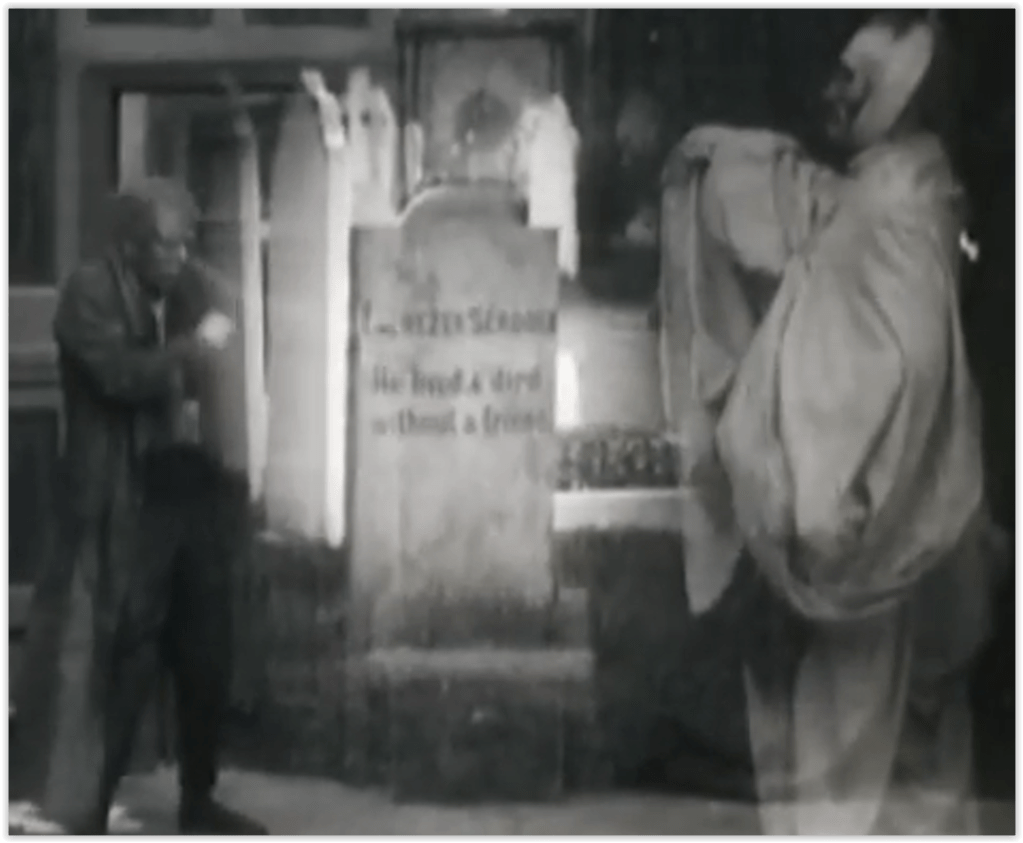
We get a tight shot of the Cratchit Christmas dinner. As Mrs. Cratchit brings in the goose, Bob proposes a toast to Mr. Scrooge, which his wife objects to. Bob changes the toast to “us all”, allowing Tiny Tim to chime in with his bless us every one. Scrooge admits he’s been a fool and asks if Tiny Tim will live. Jacob delivers the “decrease the surplus population” reply and moves immediately to Tiny Tm’s deathbed, followed by “a neglected tombstone”, on which we read that Ebenezer “died without a friend”. Scrooge implores for mercy or more time, and collapses when Jacob turns away. When Scrooge wakens (we know he’s awake because the office desks, which disappeared for a while to make room for the visions, are back) he goes back to pleading, clutching his comfy chair instead of bedcurtains. Realizing that he is still alive and that it is “not too late for me to have my first Merry Christmas”
Clapping and laughing and occasionally spinning a hand in the air above his head (something he also does in the 1935 version) he throws open the curtains and windows and calls to a boy we can’t see. When the boy enters the office, Scrooge grabs him by the collar and demands to know if Tiny Tim is still alive. Only after he is told that the boy saw Tim does Scrooge ask about the prize turkey. “Here’s gold. Gold!” Scrooge gives him money from a bag hidden inside those baggy pants and tells him to buy the turkey and take it to Bob Cratchit. And to take a cab. And to keep the change. Then, in a move seldom imitated by subsequent Scrooges, he enjoys both the Cheat Ending we mentioned in the main article AND the canonical ending.
He IMAGINES himself attending the Cratchit Christmas dinner, handing money to all the little Cratchits, kissing Tiny Tim, and causing great hilarity by producing mistletoe and kissing Mrs. Cratchit. The shabbiest person at the table, he has a good laugh (reminiscent of Fred Gwynne as Herman Munster) and no doubt proposes a “God bless us, every one” toast. (He got the last word on this in the 1935 version as well.) Back in reality, he hears carol singers outside the window and desperately scrabbles to get the coins which fell from the bag he was cuddling earlier, so he can throw these. He then rushes back inside to grab up even more coins to throw to them. After this he gets dressed (throws the coat and waistcoat back on) to make “Christmas calls”. We are told this includes dinner with nephew Fred, but do not see this.
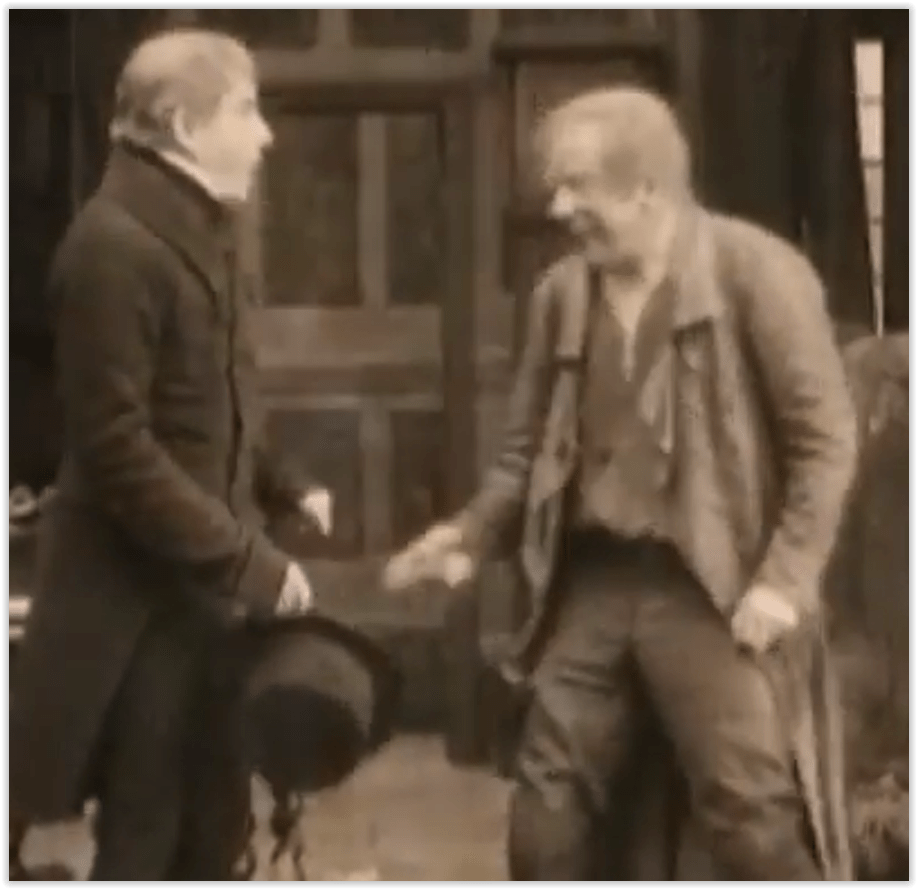
We jump to December 26 as Cratchit rushes into the office late and Scrooge plays his prank, suddenly calling his clerk “Bob” instead of “Cratchit” and eventually ordering him to go out and buy a ton of coal. He even, apparently, allows BOB to say “God Bless Us Every One”. Scrooge does get one last swirl of tone hand in the air to end the picture. (This gesture also turns up several times in the 1935 version. Must be a British thing; we see Bob make the same gesture on his way out to buy coal.)
This version does a lot of trimming and a little padding to make its points. On several points it either misunderstands Dickens’s intention or MAY be cutting corners because it is pressed for time. Not everything it attempts succeeds. But it’s a robust retelling and if you like Sir Seymour Hicks’s 1935 Scrooge (not everyone does, but I rejoice in it) then you ought to look over this scruffier take on the old miser.
Next time: a clone of Seymour Hicks apparently encounters an ancestor of Marty Feldman.
 Blogsy Babbles