Scrooge was better than his word. He did it all, and infinitely more; and to Tiny Tim, who did NOT die, he was a second father. He became as good a friend, as good a master, and as good a man, as the good old city ever knew, or any other good old city, town, or borough, in the good old world. Some people laughed to see the alteration in him, but he let them laugh, and little heeded them, for he was wise enough to know that nothing ever happened on this globe, for good, at which some people did not have their fill of laughter in the outset; and knowing that such as these would be blind anyway, he thought it quite as well that they should wrinkle up their eyes in grins, as have the malady in less attractive form. His own heart laughed; and that was quite enough for him.
He had no further intercourse with spirits, but lived upon the Total Abstinence Principle, ever afterwards; and it was always said of him, that he knew how to keep Christmas well, if any man alive possessed the knowledge. May that truly be said of us, and all of us! And so, as Tiny Tim observed, God Bless Us, Every One!
At this point, in most cinematic versions, a narrator steps in to read us those first three lines, at least, and frequently the last two, usually over a scene of Scrooge with Tiny Tim.
In Sim I, as we watch Scrooge walk along the street (at one point patting the blind man’s dog) we are told that Scrooge was better than his word. He became as good a friend, and so forth. And to Tiny Tim “who lived and got well again”, he was a second father. We watch Tim run to him, calling “Uncle Scrooge!” We are further told that it was always said of him, right through to the end of the passage. The narrator goes on to bless us, every one, and the closing credits appear over “Silent Night”.
In Rathbone, we return to the booklined room seen at the beginning, where the narrator delivers an abbreviated version of the passage.
In Sim II, as Scrooge laughs in a brightening light, the narrator gives us the first two sentences, and then the rest beginning at “It was always said of him”. The closing credits come over “God Rest Ye, Merry Gentlemen.”
In Matthau, B.A.H. Humbug tells us ”And that’s how Scrooge became as good a friend, as good a master, and as good a man, as the good old city knew. He asked for no reward, for his own heart laughed, and that was enough for him. May that truly be said of us all, and so, as Tiny Tim observed, Gpd Bless Us, Every One!” Scrooge sings “Mankind Shall Be My Business” surrounded by the Cratchits, with Fred and Mrs. Fred.
Imn Scott, a narrator gives us “Scrooge was better than his word. He became as good a friend, as good a master, and as good a man, as the City ever knew. And to Tiny Tim, who did NOT die, he was a second father”. He then jumps to “It was always said of him” and so on to the end. Meanwhile, on a sunny day, Scrooge has walked to the Cratchits’. Tim runs out to meet him. They walk off, hand in hand. A song about Scrooge, and blessing us, every one, closes off the story.
In Caine, Dickens tells us “Scrooge was better than his word. He did it all, and infinitely more.” Rizzo, anxious, asks “And Tiny Tim?” Dickens feigns sorrow, replies “And to Tiny Tim, who did NOT die….” Rizzo cries, “Aw, isn’t that swell!” “To Tiny Tim, he became a second father. He became as good a friend” and so on through that passage before skipping the usually skipped lines about intercourse with Spirits and blindness, which would be awkward nowadays, and goes to “And it was always said of him”, taking that nearly to the end. Tiny Tim calls “God bless us!” and Scrooge answers, “God Bless Us, Every One!” “The Love We Found”, a new version of “The Love Is Gone” plays while the camera pulls back across the table, out the door, and over the roofs of London (above lobsters who are singing in the windows.) Rizzo, offscreen, remarks, “Nice story, Mr. Dickens.” To which Dickens replies, “If you liked this, you should read the book.”
In Curry, we are told that Scrooge was as good as his word. No…better. He became as good a friend, and so on, “and he kept Christmas in his heart forever.” The credits roll over scenes of London.
In Stewart, we dissolve from the fire Bob is building in the office to the fire in Scrooge’s sitting room. Fred, offscreen, tells us, “My uncle was better than his word.” He reads farther from the text than most, as far as “He let them laugh, and little heeded them.” We watch the Cratchits arrive at Scrooge’s. Fred goes on “It was always said of him” and on through that passage. Scrooge lifts Tim, who says “God Bless Us Every One!” We take a long look at the other little Cratchits. Then everyone walks into Scrooge’s, and the credits roll.
AFTERWORDS
So that was the book I put together twenty-five years ago or thereabouts. I saw it as a coffee table affair, filled with stills from the various versions discussed, which might serve as an inspiration to other writers to try the same format with other books which had numerous film adaptations: Tom Swayer, say, or Hamlet, or, hey, The Gift of the Magi. Maybe one day someone will turn this into the book I expected publishers to line up for a chance to publish.
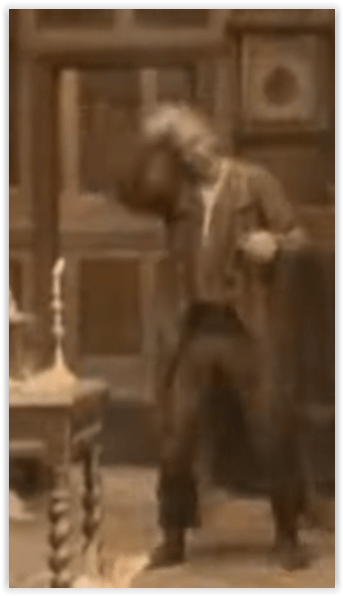
I could not illustrate even this version as I would have liked, since I do try to steer this side of copyright infringement. Where I did use scenes from the movies, I relied heavily on silent versions not discussed in the text which are old enough to be in the public domain. This included versions from:
1901: the oldest known surviving film of A Christmas Carol, long almost entirely lost except for the scene of Marley appearing in the doorknocker. Now something like 60% of the movie can be watched online. It was also long rumored that Scrooge was portrayed here by Sir Seymour Hicks, since, coincidentally, 1901 was the first year he portrayed the miser on stage, but this is now believed to be one Daniel Smith.
1910: A Thomas Edison production, notable for including as Bob Cratchit one Charles Ogle, who had earlier played Franken=stein’s monster in Edison’s version of THAT classic.
1913: This appeared under several titles (Scrooge, Old Scrooge, A Christmas Carol), but you should definitely look it up. Scrooge here absolutely IS Sir Seymour Hicks, who would portray Scrooge again, in the version we called Hicks. In this earlier film, he is as wildly eccentric as any Scrooge you’d care to see. Like a lot of silent versions, which were based on cheap theatrical productions, Scrooge sleeps in his own office (saves on sets) and, going along with the sort of CEO who would do that, he is probably the grungiest Scrooge ever, looking as if he has not changed his clothes in a monrh or bathed in a year.
1922: Scrooge is here portrayed by Henry W. Esmond, a very popular actor now best remembered as Laurence Olivier’s father-in-law.
1923: This version starred Russell Thorndike, younger brother of actress Dame Sybil Thorndike, who played opposite him in a silent version of Macbeth. He is now remembered less for his acting career than for the mysteries he wrote about the somewhat sinister vicar Dr. Syn.
Next Monday, we will start serializing another of my dazzlingly brilliant but somehow unpublished books: another nonfiction opus if I can turn up the manuscript I’m looking for, or a novel if I decide to throw to the winds all hope of becoming an Interwebs Influencer.
 Blogsy Babbles