“And how did little Tim behave?” asked Mrs. Cratchit, when she had rallied Bob on his credulity and Bob had hugged his daughter to his heart’s content.
“As good as gold,” said Bob, “and better. Somehow he gets thoughtful sitting by himself so much, and thinks the strangest things you ever heard. He told me, coming home, that he hoped the people saw him in the church, because he was a cripple, and it might be pleasant to them to remember upon Christmas Day, who made lame beggars walk and blind men see.”
Bob’s voice was tremulous when he told them this, and trembled more when he said that Tiny Tim was growing strong and hearty.
His active little crutch was heard upon the floor, and back came Tiny Tim before another word was spoken, escorted by his brother and sister to his stool before the fire; and while Bob, turning up his cuffs—as f, poor fellow, these were capable of being made more shabby—compounded some hot mixture in a jug with gin and lemons, and stirred it round and round and put it on the hob to simmer; Master Peter, and the two ubiquitous young Cratchits went to fetch the goose, with which they soon returned in high procession.
Such a bustle ensued that you might have thought a goose the rarest of all birds; a feathered phenomenon, to which a black swan was a matter of course, and in truth, it was something very like it in that house. Mrs. Cratchit made the gravy (ready beforehand in a little saucepan) hissing hot; Master Peter mashed the potatoes with incredible vigour; Miss Belinda sweetened up the apple-sauce; Martha dusted the hot plates; Bob took Tim beside him in a tiny corner at the table; the two Cratchits set chairs for everybody, not forgetting themselves, and mounting guard upon their posts, crammed spoons into their mouths, left they should shriek for goose before their turn came to be helped. At last the dishes were set on, and grace was said, It was succeeded by a breathless pause, as Mrs. Cratchit, looking slowly all along the carving-knife, prepared to plunge it in the breast; but when she did, and when the long expected gush of stuffing issued forth, one murmur of delight arose all round the board, and even Tiny Tim, excited by the two young Cratchits, beat on the table with the handle of his knife, and feebly cried Hurrah!
There never was such a goose. Bob said he didn’t believe there ever was such a goose cooked. Its tenderness and flavour, size and cheapness, were the themes of universal admiration. Eked out by the apple-sauce and mashed potatoes, it was a sufficient dinner for the whole family; indeed, as Mrs. Cratchit said with great delight (surveying one small atom of bone upon the dish), they hadn’t ate it all at last! Yet every one had had enough, and the youngest Cratchits in particular, were steeped in sage and onion to the eyebrows! But now, the plates being changed by Miss Belinda, Mrs. Cratchit left the room alone—too nervous to bear witnesses—to take the pudding up, and bring it in.
Suppose it should not be done enough! Suppose it should break in turning out! Suppose someone should have got over the wall of the back-yard, and stolen it, while they were merry with the goose: a supposition at which the two young Cratchits became livid! All sorts of horrors were supposed.
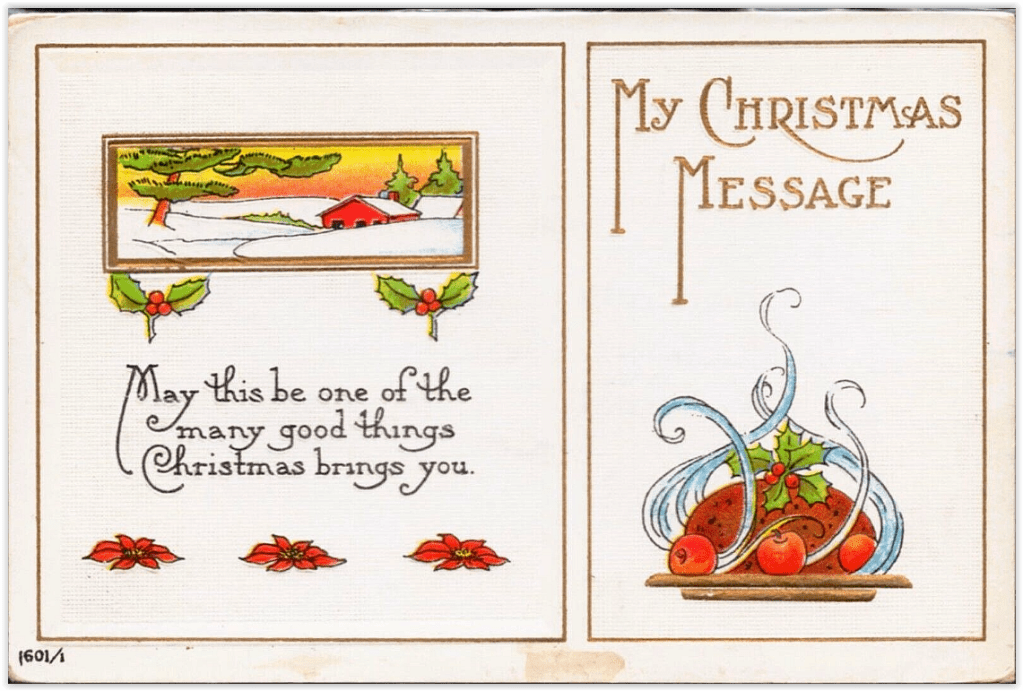
Hallo! A great deal of steam! The pudding was out of the copper. A smell like washing-day! That was the cloth. A smell like an eating-house, and a pastry-cook’s next to each other, with a laundress’s next door to that! That was the pudding. In half a minute, Mrs. Cratchit entered: flushed, but smiling proudly, with the pudding, like a speckled cannon-ball, so hard and firm, blazing in half of half-a-quatern of ignited brandy, and bedight with Christmas holly stuck into the top.
Oh, a wonderful pudding! Bob Cratchit said, and calmly, too, that he regarded it as the greatest success achieved by Mrs. Cratchit since their marriage. Mrs. Cratchit said now the weight was off her mind, she would confess she had had her doubts about the quantity of flour. Everybody had something to say about it, but nobody said or thought it was at all a small pudding for a large family. Any Cratchit would have blushed to hint at such a thing.
At last the dinner was all done, the cloth was cleared, the hearth swept, and the fire made up. The compound in the jug being tasted, and considered perfect, apples and oranges were put upon the table, and a shovel-full of chestnuts on the fire. Then all the Cratchit family drew round the hearth, in what Bob Cratchit called a circle, meaning half a one; and at Bob Cratchit’s elbow stood the family display of glass; two tumblers, and a custard-cup without a handle.
These held the hot stuff from the jug, however, as well as golden goblets would have done; and Bob served it out with beaming looks, while the chestnuts on the fire sputtered and crackled noisily. Then Bob proposed:
“A Merry Christas to us all, my dears. God bless us!”
Which all the family re-echoed.
“God bless us every one!” said Tiny Tim, the last of all.

Dinner at the Cratchits’ was one of the high points of Dickens’s public readings of the Carol: audiences rose to their feet and cheered when the pudding finally reached the table.
This sequence, and those which immediately follow, are frequently mixed, matched, and otherwise rearranged. Film-makers want to move the story along, and we really CANNOT sit and watch the family devour an entire goose (not to mention the mashed potatoes and applesauce.) You need “How did Tim behave in church?” at the start and “God bless us every one” at the end; since Tim is a hard act to follow, you can toss all the other Cratchit material in wherever it fits in between these.
In Hicks, a knock on the door proclaims the arrival of the goose. The children rush to it while Mrs. Cratchit ushers Bob to the fire. She takes his comforter while Bob brings his slippers. They discuss Tim’s behavior in church; both have to look away when Bob says he thinks Tim is growing stronger. His wife replies, “I wish I could believe you, Bob, but I’m afraid.” The goose is ushered in now by the little Cratchits. “There never was such a goose!” Bob declares, “There never will be such a goose.” Preparations move quickly while he predicts that its flavor will exceed all expectations. He mentions the applesauce and the mashed potatoes, and the family set to. The scene jumps to the end of the meal. These are the least elegant Cratchits on film: a stubby candle sits on the table, and we watch one the girls wiping her mouth on the tablecloth. ”And even now we haven’t eaten it all,” crows Mrs. Cratchit, tapping a bone on the platter. They laugh. Scrooge chuckles, which the Ghost observes. “I envy them,” Scrooge admits. Now Bob Notes “Regarding the momentous question: pudding.” There is a tumult; he further observes that his wife looks pale, maybe, and nervous. She says she prays all will be well with the pudding. She and Tim go to fetch it while the other Cratchits clear away and wash the dishes. Bob troubles the children with horrible suppositions regarding the pudding while Tim, in the next room, lights the brandy. Bob dims the lights as the pudding arrives, flaming; he pronounces it a beautiful pudding. “A Merry Christmas to us all, my dears!” he exclaims, dishing it out. “God bless us all!” cry his children. “Good bless us all!” says Tim, who, exhausted by all this adventure, leans heavily on his crutch. He raises his eyes to his father.
In Owen, Bob and Martha have moved into the kitchen to mix the punch. Martha senses something is wrong. Closing the door so the others won’t hear, Bob admits that he has been sacked by Mr, Scrooge, but asks her not to mention it to her mother. They move into a very well-appointed dining room, airy and nicely furnished. Peter is sent for the goose, which shortly appears on the table. Everyone eyes it hungrily; Tim can’t keep his hands still for all the excitement. “There never was such a goose!” Mother carves, and we fade to the finish of the meal. “We haven’t eaten it all at last!” Bob suggests the possible theft of the pudding as a joke to Tim; an anxious wait follows. One of the girls give bulletins from the kitchen door; by the time the pudding arrives, Scrooge’s face is as alive with anticipation as any of the others. Mrs. Cratchit serves the pudding around, taking none herself. Martha forces a spoonful on her. The Spirit repeatedly beams his light on the family. The two toasts—blessing us from this segment and the founder of the feast from the next—are blended.
In Sim I, we get a bit of Martha’s speech from the previous segment, and then the discussion of Tim’s behavior in church. Immediately after Bob fails to convince himself that Tim is growing stronger every day, we insert the “Will Tiny Tim live?” sequence. The arrival of the pudding is discussed; we then cut to the empty table and the punch.
When March fades in at the Cratchits’, they are singing the Ghost’s song themselves, decorating their light, airy front room while preparing food. Peter, a tall young man, is snitching bits of this and that; the goose is roasting on a spit. They borrow the riddle game from Fred’s party; Scrooge plays along eagerly but is offended by the solution. Bob repeats “He said Christas was a humbug!” While the children finish trimming the Christmas tree, the parents discuss Tim’s behavior in church; Bob tries to convince himself “He’ll see many a Christmas after us.” Mrs. Cratchit finds the cheer fantasy of this devastating; even Bob mutters “A few more shillings a week.” Mrs. Cratchit tries to cheer him up, saying “A cheerful heart is the best healer.” Tim sets the star on top of the tree and then sings “God Bless Us, Every One”. Scrooge is transfixed. (I hate to complain, by the way, but what in the WORLD is Tim wearing?)
In Rathbone, all the Cratchit scenes are compressed into a kind of medley. Bob sets Tim by the fire and compliments Martha on her mashing of the potatoes. The Cratchits go into raptures at having a whole goose to themselves. (The bird involved is the size of a modest chicken.) Four of them pull up to the table now; Bob cries, “Three cheers for the Cratchits!” They appear to have completely forgotten about Tim, who is still sitting by the fire, and now asks if he can come to the table. Bob, unabashed, lifts the boy and brings him over. Bob then says grace and suggests that God bless them; Tim augments the toast as in the text.
Magoo’s Mrs. Cratchit brushes away a tear as Bob discusses Tim’s behavior in church. The smallest of Cratchit dinners—basically bread and soup—is set out as everyone sings “Razzleberry Dressing” (officially known as “The Lord’s bright Blessing”.) This is a rousing little number completely at odds with Dickens’s uncomplaining Cratchits. (On the other hand, Dickens gives them more food.) In any case, the young Cratchits are quickly convinced that being together is better than having a lot of stuff at Christmas. The song concludes with a request that “God bless us, every one!”
In Haddrick, Bob concludes the discussion of Tim’s behavior in church with “As good as gold. He’ll see many a Christmas yet, I’m sure.” Tim doesn’t look it; as Peter goes off with the two little Cratchits to fetch dinner, a fragile, dispirited Tim slumps by the fire. Scrooge, meanwhile, asks how such a dull and rational fellow as Cratchit can become so irrational this night. “He is with his family, and they make him happy.” “They make him poor, that’s for certain. But poverty seems to weigh light enough on him.” “It’s Christmas!” “But they have nothing to celebrate Christas wth!” “It is the spirit of the evening that makes small things great and inadequate things seem beautiful.” “I don’t understand you.” “That is why you are here.” Scrooge insists he need no such intangibles to make things meaningful. “Now, take money…..” “You do that often enough. I don’t want to hear about it.” The family sit down to what Scrooge has called a sad, inadequate dinner; his is now amazed to watch them enjoy it. “Bless my soul!” “That is our intention, Ebenezer Scrooge. I think we may be achieving it. Slowly.”
Sim II gives us only the discussion of Tim’s behavior in church. Scrooge lowers his eyes, abashed, at being reminded of who made lame beggars walk and blind men see. We skip ahead to the family gathered around the fireside; Tim sings one line of “The Little Boy lost in the Snow” and then we bless us, every one.
Finney watches the goose and the punch being prepared. Bob is quite over the top enjoying the preparations; everyone else seems to enjoy how much he enjoys them. The goose is not much larger than Bob’s two hands. Tim and a brother return from carol-singing, having earned tenpence ha’penny. Tim is toasted as a breadwinner by his father, which takes us to the next scene.
In Matthau, Tim proceeds to a teeny Christmas tree and exclaims at Santa Claus’s generosity. “Not at all like Mr. Scrooge,” says one of his sisters. Everyone else boos at the mention of the name, but Tim tells them not to think unkindly of Mr. Scrooge: not at Christmas. “Why not? It’s his thinking that keeps us poor.” Bob, skipping around in the text, joins Tim by saying “Now, Mr. Scrooge is the founder of the feast.” “:Feast?” his wife demands. “With a goose no bigger than a canary bird?” Scrooge turns to the Ghost and demands, “Must I listen?” :Surely you’re not surprised.” Surprised or not, Scrooge is stricken. “Oh, instead of docking Bob, why didn’t I give him exytra for Christmas?” Tim hobbles off to get his new toy, a wooden soldier. Mrs. Cratchit admits that sometimes she loses hope that Tim will ever get well, and wishes they had the money to see him cured. Bob replies that Tim has the hope and faith he needs. In fact, in church, he said he hoped the people saw him, and so forth, at last, from the original text.
All we get of this from McDuck is Tim exclaiming, “Look at all the wunnerful things to eat!”
In Scott, Bob remarks on Tim’s behavior in church, but Scrooge is watching the two children escort Tim from the room. “Look at how they support him!” “What did you say?” the Ghost inquires. “Nothing. It’s…. Nothing.” Mrs. Cratchit looks tragic when Bob notes how Tim is growing stronger every day. “Yes, Bob. I’m sure you’re right. He is getting stronger.” In every version, Mrs. Cratchit declines to believe this, but here you can tell from Bob’s face that he knows she doesn’t. He tells her, clutching the crutch to him, that the important things is that they’re all JHERE. Pulling a later section out of the text, Bob reveals that he has a position in mind for Master Peter, working for Mr. Scrooge’s nephew, Fred Halliwell. Scrooge is affronted: who would hire a child at such an exorbitant salary? Fred must be doing it to spit him. The goose comes to the table and is much praised. Bob carves this goose; he also says grace, to which Scrooge says “Amen.” “Did you say something?” “No.” “I thought I heard….” “I said nothing.” “Oh.” The family dines. “A very small goose,” Scrooge observes. “It is all Bob Cratchit can afford.” Scrooge is offended again. “Berry Christmas to us all!” “And God bless us, every one!” Bob is much struck by Tim’s addition of this.
In Caine, Tim is so excited by the feast that he begins to cough. His mother makes him sit down, and asks how he h=behaved in church. Bob tells her, his voice breaking. “A remarkable child,” says Scrooge. The food is spread out on the table and they set to. Scrooge observes, “Such a meagre feast.” “But very much appreciated.” Scrooge will not be comforted. “O pay Bob such a small amount.” Then he hears his name, and we are brought to the toasts.
In Curry, we hear how Tim behaved in church, but Scrooge is confused by “As good as gold. No, better.” “There’s something better than gold?” he demands. We move quickly to empty plates and the Toast.
In Stewart, we are told how Tim behaved in church as Bob tries to ease his shoulders. Mrs. Cratchit replies to who made lame beggars walk and blind men see by saying “Not many remember that. You can count on it.” Bob says he thinks Tim is growing stronger; Martha seconds this notion. The goose is brought to the table and Mother carves; there is a decent attempt to reproduce the text on screen. They joke with Tim about the food; Scrooge injects “Will Tiny Tim live?” at this point. Meanwhile, the Cratchits have arrived at worrying whether the pudding is all right. Martha helps her mother lift it out of the copper; lighting the brandy produces a tiny flame. There is much business as Bob takes the first taste; Mrs. Cratchit’s relief when he pronounces judgement is profound. The Ghost explains to Scrooge “There’s nothing wrong with that pudding except that it’s a very small pudding for such a large family.” Scrooge replies that nobody complained. “Any Cratchit would blush to even hint at such a thing.” We proceed to “God bless us, every one!”
 Blogsy Babbles